
Bird Lovers Build Bird Database
Air Date: July 03, 2009
Ken Pauley is an avid birdwatcher. Now his love of birds is keeping him indoors. Pauley is one of numerous volunteers who are sorting through six million handwritten cards documenting bird sightings between 1880 and 1970 and transferring the information into a computer database. As Amy Mayer reports, the information could help researchers’ efforts to find out more about bird migration and the effects of climate change.
Transcript
CURWOOD: Birders have a long history of helping scientists. It's so long, in fact, that many records of their sightings now exist only as dusty cards tucked away in basements.
But one current effort has volunteers organizing bird observations from the 19th century to make them accessible. Amy Mayer visited the home of a volunteer in Acton, Massachusetts and has our story.
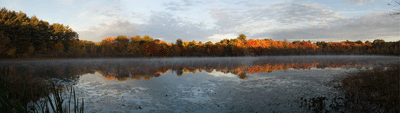
MAYER: The living room in Ken Pauley's suburban Boston home has windows on three sides. He keeps binoculars handy—to watch the geese on the pond, the hummingbirds at the feeders and the red-winged blackbirds landing on the closest tree.
BIRD SOUNDS AND WALKING SOUNDS
MAYER: Pauley points to the five nesting boxes he maintains for the ducks and the native plants that will create a meadow as they grow all summer. The mini conservation area on his 10 acres is rich with wild blueberry and azalea bushes and the cacophony of birdsongs.
WETLAND SOUNDS
PAULEY: That's a red-winged blackbird.
MAYER: Pauley began birding as a child in the Blue Hills just outside Boston and quickly befriended adult birders, who took him further afield. When he was twelve or thirteen, a friend invited him to go birding with a legendary pair.
PAULEY: So we jumped in his car, drove out to Ipswich River Valley Sanctuary and met the two guys. One was a white haired gentleman, another guy was a Brit. And the British fellow was Carl Fischer, quite an ornithologist in England. And the other fellow was Roger Tory Peterson.
PAULEY: We were walking along and Roger and I would just be walking and we’d stop and say, "black throated green" just by songs, and I'd say, yellow warbler and we would be just calling out because of the sounds. So for about three weekends I birded with Roger and Carl Fischer and Arthur Katz and it was a phenomenal experience because talk about, you know, people dedicated to ornithology. And of course to be birding with the author of the book that I’ve got in my hand was a great thrill.
MAYER: Pauley's passion for birding folded into his 43-year career as an educator at Boston's Museum of Science. He even leads safaris in Tanzania. Now retired, he brings his love of birds inside, too.
PAULEY: Now I have to log in, so I use my email address …
MAYER: Pauley sits at a small desk beside a picture window and enters the website for the North American Bird Phenology Program. It's a project sponsored by the U.S. Geological Survey to make six million cards useful. The cards document sightings from volunteer birders between 1880 and 1970. Pauley squints at the jpeg image that appears on the screen.
MAYER: The cards contain the bird species, location, dates and observer's name. Pauley says he's probably transcribed about 60 cards. That's part of the 70,000 cards documented so far by volunteers across the country. They rely on another group of bird lovers who go the USGS office in Laurel, Maryland six days a week to scan them in. USGS biologist Jessica Zelt coordinates the program.
ZELT: We've basically pulled all these cards out of storage; they've been stored for about 40 years in basements and attics and storage facilities and we're finally getting the recognition of how important these cards are; so we were able to pull them out and we're in the process now of digitizing them.
MAYER: Most of the birders were trained naturalists and scientists. Their observations tell the story of changing habitats and migration patterns.
ZELT: I have here another card, which was on the ivory billed woodpecker. It was in Jane Green Swamp, Florida, and it says here that Henry Redding saw four in January of 1923, and that was recorded in December…
MAYER: And there are introduced species seen as exotic a hundred years ago that are now familiar, such as starlings and house sparrows. Habitats also change. Cardinals rarely lived in New England in the mid-20th century, but now they're permanent residents here. Zelt says the data from the cards can help quantify these types of changes. And she's collecting records kept by researchers since 1970 to create a 120-year dataset that she says,
ZELT: Really could show us a lot about what’s happening with bird migration and climate change and what the effect is of climate change on these birds, on a nation-wide scale.
MAYER: While Pauley is interested in the science—and happy to be helping with it—when he's transcribing, he's got his eye out for his boyhood heroes.
MAYER: Even if it doesn't, Pauley enjoys being among the volunteers making this vast information accessible to researchers.
For Living on Earth, I'm Amy Mayer in Acton, Massachusetts.
MUSIC: Dapp Theory “Bird Calls” from Layers Of Chance (ObliqSound 2008)