Living on Earth: August 21st, 2009
Air Date: August 21, 2009
Four years after Hurricane Katrina, New Orleans residents have read the official word on why the levees failed in the aftermath of the storm. It was a dense report from the Army Corps of Engineers, that was then evaluated by the National Academies of Science. Host Steve Curwood asks David Moreau from the National Academies of Science to help make sense of the government report – but it may not reassure New Orleans residents in flood-prone areas.
Food Deserts
7 min read · 9 min listen
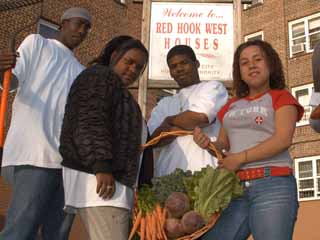
Many low-income neighborhoods in the United States lack access to fresh and affordable fruits and vegetables. Residents in these so-called ‘food deserts’ rely on neighborhood corner stores and fast food chains as their main sources of food. But as Jessica Ilyse Smith reports from New York City, a number of programs are working to close the food gap by bringing healthy foods closer to home.
Harvesting Emissions
5 min read · 7 min listen
The world's farmers bring us food, clothes, and increasingly - greenhouse gas emissions. Through crop and livestock production and land clearing, the world's agricultural sector is a bigger contributor to global warming than the transportation sector. Economist Sara Scherr, CEO of Ecoagriculture Parters, says it’s time to start looking at farmers as environmental stewards, not just food producers. She speaks with Steve Curwood about techniques that help farmers mitigate and adapt to climate change.
In Search of Silence
9 min read · 12 min listen
Gordon Hempton has traveled the world in search of undisturbed natural sound. But as the audio ecologist describes in his new book, “One Square Inch of Silence; One Man’s Search for Natural Silence in a Noisy World,” it’s getting harder and harder to find pure natural sound. Hempton has launched a campaign to raise awareness about noise pollution, and tells Steve Curwood why silence matters.
Note on Emerging Science
2 min read · 2 min listen
New research shows that honey bees do even more to help flowers than we ever knew. Jessie Martin reports on honey bee bodyguards and their implications for sustainable farming.
Out of the Box Housing
4 min read · 5 min listen
The increasing push to reuse materials has given some entrepreneurs a bright idea. Living on Earth’s Ingrid Lobet reports on how steel cargo shipping containers are becoming homes.
Seedy Art
3 min read · 4 min listen
At the Minnesota State Fair, seeds aren't just for planting – they’re used to create works of art. Living on Earth's Bobby Bascomb produced our audio postcard.
The Art of Mud
3 min read · 4 min listen
When commentator Bethany Ericson’s adult brother had some time on his hands, he decided to take up the Japanese craft of making perfect balls of mud. But his sister says the interest soon turned to obsession.
The Language of Landscape
2 min read · 2 min listen
Living on Earth continues its series exploring features of the American landscape, based on the book Home Ground: Language for an American Landscape, edited by Barry Lopez and Debra Gwartney. In this installment, Barry Lopez explains the term “soil.”
There Will Be Flood
4 min read · 5 min listen
Four years after Hurricane Katrina, New Orleans residents have read the official word on why the levees failed in the aftermath of the storm. It was a dense report from the Army Corps of Engineers, that was then evaluated by the National Academies of Science. Host Steve Curwood asks David Moreau from the National Academies of Science to help make sense of the government report – but it may not reassure New Orleans residents in flood-prone areas.