
Note on Emerging Science/Solar Storage
Air Date: June 25, 2010
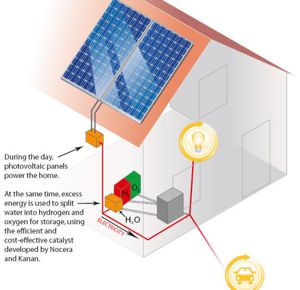
Renewable energy technologies have long been plagued by a lack of storage. But scientists have developed a new technology that promises to store the sun’s energy all day and night. Emily Guerin reports.
Transcript
YOUNG: It’s Living on Earth, I’m Jeff Young. Just ahead – New York locavores go to new heights on a Queens rooftop – but first this note on emerging science from Emily Guerin.
THEME
GUERIN: Installing a wind turbine at home: $30,000. Switching to geothermal heat: $20,000. Powering your home with the sun and a bucket of water? Priceless. Well, not quite priceless. But MIT researchers have discovered an inexpensive way to harness and store the sun’s energy. The new technology only needs 5 liters of water, 4 hours of sun and a 16 x 20 foot array of solar panels to produce 30 kilowatt hours of electricity. That’s enough to power a four-person household all day—and night.
When the sun is shining, solar panels power household appliances. Any excess electricity is run through a container of water containing two catalysts and an electrode, splitting the water into hydrogen and oxygen gas. The two elements are stored separately during the day and recombined in a fuel cell to power the house at night. There’s even enough energy left over to charge an electric car. And there may be global applications for the technology.
It can run off untreated water, saving clean water for drinking. The scientists are testing it with water from Boston’s Charles River. The new technology is a lot cheaper now since researchers started using inexpensive metals like nickel as their catalysts. But it still requires a hefty investment in solar panels. But what it promises—that our homes will become our power plants—is pretty attractive, even to a penny-pincher. That’s this week’s Note on Emerging Science. I’m Emily Guerin.