
BirdNote® What Do Birds Smell?
Air Date: July 13, 2012
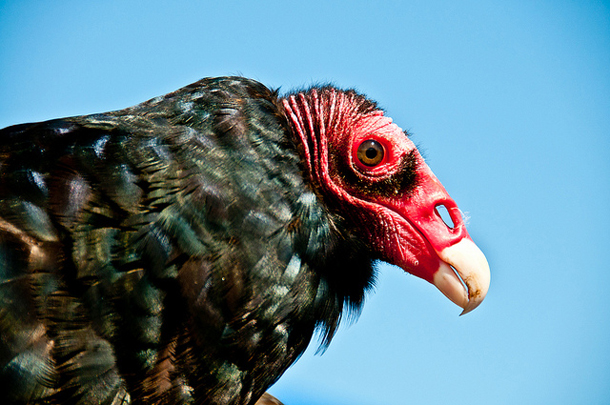
It’s summer and that means it’s time to wake up and smell the roses. And, as BirdNote®’s Michael Stein reports, birds are doing a lot of sniffing this time of year.
Transcript
BIRD NOTE® THEME
GELLERMAN: They may be small and flighty - but don’t call them bird brains. Birds have mighty keen senses----and BirdNote®’s Michael Stein has a nose for a good story.
STEIN: Birds are justly renowned for their highly sensitive eyesight and hearing. Consider the exquisitely keen eye of the eagle, [Bald Eagle call] or the unerringly acute ear of the owl [A brief bit of Great Horned Owl calling]. But what about birds’ sense of smell? Among the many birds of the world, some are, without doubt, prodigious smellers.
Ocean waves
Diminutive seabirds called storm-petrels are olfactory savants – they can detect the scent of prey from a distance of 25 kilometers! The kiwis of New Zealand sniff the ground for earthworms
Sniffing sound
Before probing deeply to intercept their wiggly prey. Turkey Vultures also have a supremely keen sense of smell to lead them upwind from great distances to their malodorous feasts. Songbirds were long thought to have a poor sense of smell, because the olfactory center in their brains is proportionally tiny. However, current research suggests that some songbirds may use smell to find food, select prime nest material, and even help navigate across vast regions.
Gray Catbird
Experiments in the US with migratory Gray Catbirds show that, for adult birds repeating a migration route, sense of smell is more important than either orientation using the sun or using the earth’s magnetic field. It may well be that many songbirds “smell” their way back to last year’s nesting site. [Brief bit of Gray Catbird. I’m Michael Stein.
GELLERMAN: To see photos of some champion avian sniffers, follow your nose to our website at LOE dot org.
Related Links
- Bird audio provided by The Macaulay Library at the Cornell Lab of Ornithology, Ithaca, New York. Bald Eagle call recorded by J. R. Storm. Great Horned Owl duet recorded by W.R. Fish. Fox Sparrow song by L.J. Peyton. Gray Catbird song recorded by G.F. Budney. Gray Catbird call recorded by W.L. Hershberger. Brown Kiwi calls recorded and provided by Martyn Stewart, naturesound.org
- BirdNote® What Do Birds Smell? was written by Bob Sundstrom.