
Protecting Marine Biodiversity in Brazil
Air Date: August 03, 2012
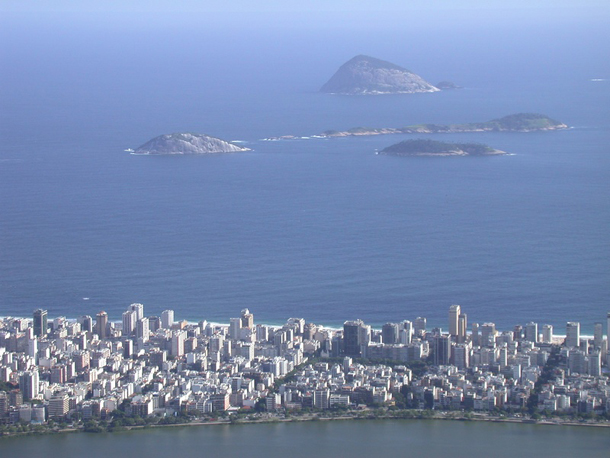
The Cagarras Islands archipelago near Rio de Janeiro, Brazil received federal protection in 2010. As Living on Earth’s Bobby Bascomb reports, scientists are already seeing successes for marine biodiversity conservation there.
Transcript
CURWOOD: It’s Living on Earth, I'm Steve Curwood. Brazil is renowned for biodiversity. There’s the Amazon rainforest of course, but the Atlantic Ocean offshore from Brazil is also teeming with diverse life. Now, that marine life is getting more attention from conservation organizations and the Brazilian government. Living on Earth’s Bobby Bascomb visited a recently protected marine ecosystem in the south of Brazil and has our story.
BOAT ENGINE SOUNDS
BASCOMB: From a motor boat driving parallel to the white sands of Ipanema beach you can see rainforest draped mountains and the iconic statue of Christ with his arms spread wide above the famously beautiful city of Rio de Janeiro.
Just three miles south of Ipanema are the picturesque Cagarras Islands, where tourists and locals come to scuba dive and fish. Fernando Moraes is a marine biologist with the national museum of Brazil. He stands on the bow of a motorboat anchored off one of the islands.
MORAES: This is very common this kind of fishing, recreational fishing spending the day here fishing and drinking beer of course. You can see by the shapes of the men.
MUSIC FROM BOATS
BASCOMB: Samba music carries across the water as pot-bellied men in tiny Speedos stand on their boats and cast fishing lines into the choppy sea. When the sun gets too hot, people jump in for a swim; if they’re lucky they might just spot a dolphin.
PEOPLE TALKING BETWEEN BOATS
BASCOMB: These islands and the water around them are full of rare endemic species, found nowhere else on earth. The ocean here is especially rich in tropical fish, and sponges only recently described by science. Above the water the islands attract birds that come here to nest and breed. Flocks of birds fill the sky - brown boobies with bright blue legs - black and white frigate birds with bulbous red throats that they puff out to attract a mate.
MORAES: The ones with the big red throat, they are the males of the frigate birds and we are in the middle of the nesting season. Most of them with the red color very brilliant. And that’s a signal for the female that they are the strong ones. They have been successful in catching fish, that they will be able to feed their young.
BASCOMB: The sky is just thick with birds do you have any idea how many there are out here?
MORAES: We have an estimate about five thousand frigate birds nesting on these islands and more; about two thousand brown boobies.
BASCOMB: Those numbers make the Cagarras Islands archipelago the second largest nesting area in Brazil for boobies and frigate birds. In 2010 the six islands became Brazil’s first federally protected natural marine monument. Divers and fishermen can still come and enjoy the water but they are not allowed to catch anything within 30 feet of the islands.
People are not allowed land on the islands anymore either, leaving nesting birds in peace.
Before the islands were protected, fishermen camped here and often left trash behind. Volunteers took more than 175 pounds of garbage from one island in a single clean up day.
CAR STREET SOUNDS
BASCOMB: The biggest concern for the Cagarras islands is pollution from Rio de Janeiro. It’s just three miles away and is home to more than six million people. It’s also one of the largest industrial ports in the country. Fabiana Bicudu is in charge of the Cagarras Island project for the government of Brazil.
BICUDU: We are very near a big city so we have impacts like organic waste. Organic waste that comes from the city, and also the big vessels waiting to enter the city and we have the residual oils in the water because of these activities.
BASCOMB: There’s another potential threat from oil: drilling. On the horizon are a handful of deepwater oil platforms. Petro Bras is the largest oil company in Brazil and also the sole sponsor of this island conservation project. It paid for the nesting bird count and all of the scientific research related to the project. Petro Bras invests in conservation programs like this to offset some of their environmental impacts elsewhere.
SOUND OF CAR DRIVING BY
BASCOMB: In the two years since the islands gained federal protection Fabiana Bicudu is already counting successes. In the past fishermen used bombs and poison to force fish to the surface, but no longer.
BICUDU: We don’t see these kinds of activities any more on the islands. It is better because divers and visitors feel safety to be there so we have bad users coming out and good users come in.
BASCOMB: And the government wants to encourage good users and sustainability. In the future, it plans to increase the 30 feet no fishing zone but marine biologist Fernando Moraes says even 30 feet is significant.
MORAES: That by itself is very important because you have a place for the fish to reproduce, and birthrates and all that, and a place where nature is allowed to develop itself without any kind of pressure. It’s very important.
BASCOMB: The shallow rocky margins of the islands are nurseries for marine life. The government has been working with local fishermen to educate them about the importance of this area for breeding fish. The message seems to be paying off. Manasi is 23 years old and has been fishing here since he was 12.
MANASI (Speaking Portuguese): My father fished here, my grandfather, my great grandfather, many generations. I think this is a very important area for the fish to reproduce. So if we protect it now, there will be more fish for us to fish in the future.
BASCOMB: That’s the hope, though of course they don’t yet know if it will work. But for fishermen, tourists, and environmentalists, Rio’s first federally protected marine monument is a promising first step. For Living on Earth I’m Bobby Bascomb in Rio de Janeiro, Brazil.
SOUND OF WAVES
CURWOOD: Our story from Brazil was made possible by a fellowship from Earth Journalism Network. For pictures of the islands, sail on over to our website LOE dot org.