
BirdNote: Pacific Wren
Air Date: October 19, 2012
To human ears birds' songs sound quick and repetitive but BirdNote’s Mary McCann reports that to another bird the same song might sound like a complex operatic aria.
Transcript
CURWOOD: Hearing the birds sing is one of the great pleasures of being out in the country - or even in your own garden, if you're lucky enough to have one. But as BirdNote®'s Mary McCann points out - even though we can listen and enjoy - human ears can miss a lot.
MCCANN: Listen carefully to the song of the Pacific Wren.
SONG OF THE PACIFIC WREN
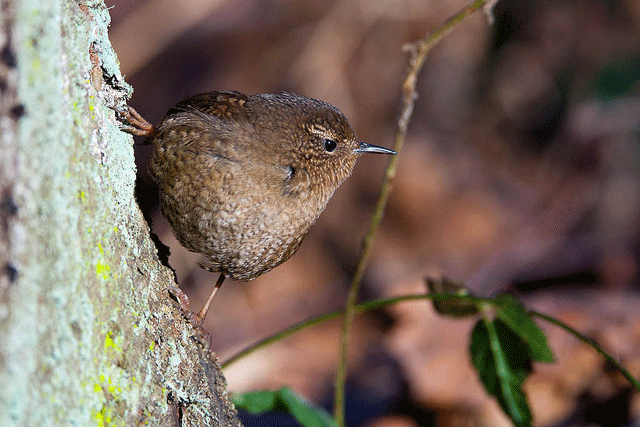
MCCANN: What we hear as a blur of sound, the Pacific Wren hears as a precise sequence of sounds. That birds can hear so acutely the fine structure of song allows them to convey much information in a short sound. “This is probably why," naturalist Rosemary Jellis writes, "even the most extensive bird songs seem so brief to us. The bird, with its speeded-up time sense, must feel as if it had sung the equivalent of an operatic aria.” Let's listen again, but this time with the song slowed down to one-quarter speed.
SONG OF THE PACIFIC WREN AT 1/4 SPEED
MCCANN: Pacific Wrens may hear the song of other Pacific Wrens this way, enabling them to imitate each other. The same would be true for Winter Wrens of the eastern states and Eurasian Wrens. Whatever the species, they remind us that creatures we share the world with, read and respond to nature in ways we sometimes cannot see or hear.
SONG OF THE PACIFIC WREN AT 1/4 SPEED AGAIN
MCCANN: I’m Mary McCann.
CURWOOD: And you can check out the pictures of Pacific Wrens over at our website, loe dot org.