
BirdNote © Sage Grouse
Air Date: March 15, 2013
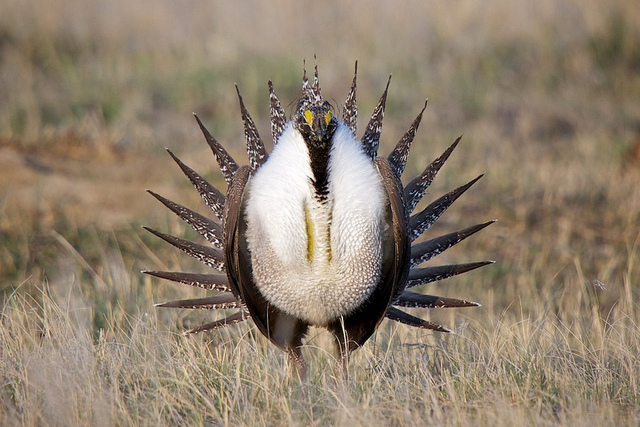
In spring, male Greater Sage-Grouse go to traditional areas, called leks and compete to lure females to mate with elaborate and noisy displays. But as Michael Stein reports, the birds are endangered.
Transcript
CURWOOD: Well, as Sarah Uhlemann noted, habitat loss is a major threat to many creatures - including one of our very own - the Greater Sage-Grouse. The US Fish and Wildlife Service has concluded the birds do need Endangered Species Act protection, but other creatures are even more threatened, so they'll have to wait. Meantime, as Michael Stein explains in today's BirdNote®, Sage-Grouse put on a wonderful show.
STEIN: Dawn breaks across the sagebrush country of the West on a brisk March morning.
SAGE-GROUSE MALES PERFORMING
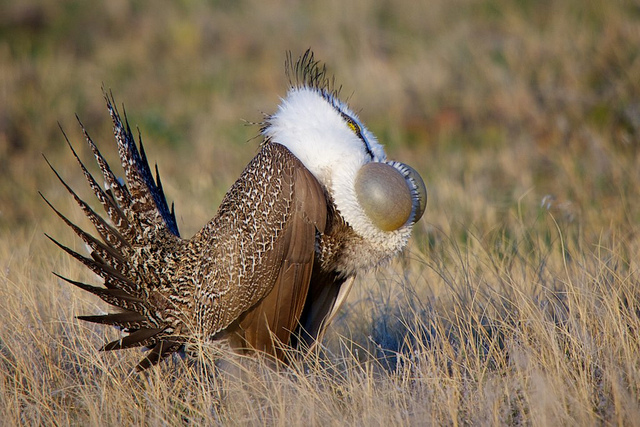
Already, fifteen male Greater Sage-Grouse are strutting on their traditional display area, a sparsely vegetated arena amid the sage.
SAGE-GROUSE MALES PERFORMING
As the sun rises, meadowlarks begin to sing.
WESTERN MEADOWLARK SONG
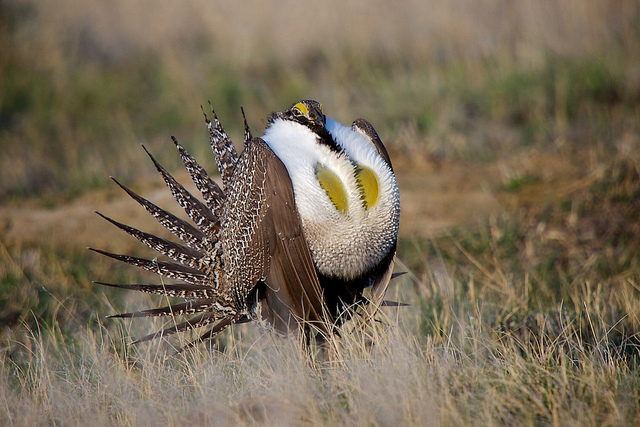
And we can now see the Sage-Grouse clearly. The enormous males are over two feet long, and weigh six pounds. They stand bolt upright, their long tails fanned like a turkey’s tail, the dark backs and bellies contrasting sharply with their white breasts. When they display, the sage-grouse simultaneously scrape their wings back and forth against their flanks, expel air from twin, fleshy chest-sacs the size of tennis balls, and call softly. The resulting sound combines swishing, popping, and cooing.
SOUNDS OF SAGE-GROUSE MALES PERFORMING ON LEK
At the display area, known as a lek, the male Sage-Grouse perform for mating rights with the smaller females looking on.
SOUNDS OF SAGE-GROUSE MALES PERFORMING ON LEK
As lands formerly covered in sage are converted to agriculture, so goes the fate of the magnificent Sage-Grouse. In some areas, the grouse have less than ten percent of their historical range.
SOUNDS OF SAGE-GROUSE MALES PERFORMING ON LEK
I’m Michal Stein
CURWOOD: To see some photos of the Sage-Gouse and leks, strut on over to our website loe.org.
Written by Bob Sundstrom Bird sounds provided by The Macaulay Library of Natural Sounds at the Cornell Lab of Ornithology, Ithaca, New York. Display sounds of the Greater Sage-Grouse recorded by G.A. Keller; call of the Western Meadowlark recorded by W.R. Fish Producer: John Kessler Executive Producer: Chris Peterson © 2013 Tune In to Nature.org March 2013 Narrator: Michael Stein