
Robins on the Hunt-By Ear
Air Date: May 03, 2013
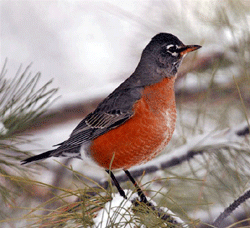
You may have noticed the way robins jauntily cock their heads as they hop along the ground this time of year. Turns out they're listening, very carefully, for the movements of worms under the grass. Jeff Rice reports.
Transcript
CURWOOD: Now one of the other drivers of soil structure is the world of life under the grass - the many invertebrates that mostly we don't think about. But as the world starts to bloom, and breed, robins are busy listening for the sound of that world below. From the Western Soundscape Project, Jeff Rice listens in.
RICE: Take a listen to your lawn for a minute, just beneath the soil.
SOUND OF MOVEMENT IN THE SOIL
RICE: Those are earthworms.
MONTGOMERIE: The worms are moving through the soil and the little particles of sand are hitting against each other.
RICE: That's Dr. Bob Montgomerie of Queen's University in Canada. He made these recordings. Chances are you've never heard earthworms before.
MONTGOMERIE: No, they're extremely quiet. The only way we were able to record them was to put them in a chamber called an anechoic chamber and use a very high sensitivity directional microphone. One that would pick up a human's voice at a couple of hundred meters and pointing it right at the soil about centimeter from the worm.
RICE: So you might think that such a very, very quiet sound would be pretty insignificant. Hardly a sound at all really. But consider this. Next time you see a robin on your lawn...take a look at how it catches worms.
ROBIN CHIRPS
MONTGOMERIE: Well, way back into the 1800s, people writing about robins have thought that they were listening when they were foraging on lawns. You see a robin hopping along and then it cocks its head and lots of people, lots of naturalists have written popular articles saying that they were listening for worms.
RICE: Nothing was scientifically proven until several years ago when Dr. Montgomerie and a colleague were taking a break from their usual fieldwork -- Dr. Montgomerie studies, among other things, reproductive behavior in birds -- and they noticed robins cocking their heads toward the ground.
MONTGOMERIE: You know, it really looks like they're cocking their head and listening.
RICE: They decided to answer the question once and for all and devised a series of experiments.
MONTGOMERIE: Well, we caught a few robins. We were working on them anyway. We were studying the way that they look after their babies and choose mates. And so we grabbed a couple and put them in an outdoor aviary that we had at our field station. And then we designed a careful experimental protocol to try to eliminate each of the sensory modes in order.
RICE: They tested everything short of robin ESP. They hid worms behind barriers. Eliminated the possibilities of smell and touch. But just based on hearing, robins...
MONTGOMERIE: Found the worms with no problem.
RICE: The two scientists published their findings in the journal Animal Behavior. Just how a robin is able to hear something as quiet as an earthworm is still unknown, but they are not the only birds that can locate food this way. Magpies are also known to locate scarab beetle grubs in the ground through hearing. For Living on Earth, I'm Jeff Rice.