
BirdNote© How Feathers Insulate
Air Date: February 14, 2014
When the weather's frigid, tiny birds like sparrows fluff up their feathers until they look like little round puffballs. As Michael Stein explains in today’s BirdNote©, it's how they keep warm.
Transcript
CURWOOD: Now in much of the US, we've been enduring some ferociously frigid weather, the kind that makes you want to snuggle down under your nice down comforter and say, "wake me up in May!" You might pity poor creatures that live outside in this cold, but as Michael Stein explains in today's BirdNote, some of them are very well protected.
CANADA GOOSE HONKING, AND SOUNDS OF WATER
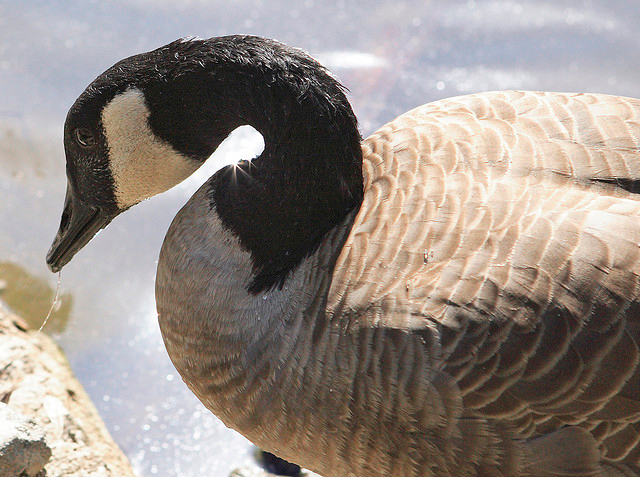
STEIN: Imagine this Canada Goose paddling along on a cold winter day. Can you guess how many feathers cover this goose? Hundreds? Thousands?
MORE HONKING

A single Canada Goose has between 20 and 25 thousand feathers. A smaller bird like a sparrow or wren might have 7 to 10 thousand. Those feathers are uniquely designed to help the bird fly, shed water, or display distinctive markings. A great many feathers are the short, fluffy kind, the down, whose purpose is to insulate the bird from the cold.
Birds survive in sub-zero weather by fluffing their feathers, creating layers of air and feathers. Just a fraction of an inch of this insulation can keep a bird’s body temperature at 104 degrees, even in freezing weather.

People learned years ago how well goose-down insulates and began stuffing comforters, sleeping bags, and clothing with it. More recently, we’ve developed artificial substitutes, but geese and other birds continue to get along just fine with the original material.
MORE CANADA GOOSE HONKING

January is a good time to begin a new volunteer activity, and Audubon chapters can help you find your niche. After all, “nicher” in French means to nest.