Science Note: Reducing Bovine Belches and Global Warming Gases
Air Date: August 01, 2014
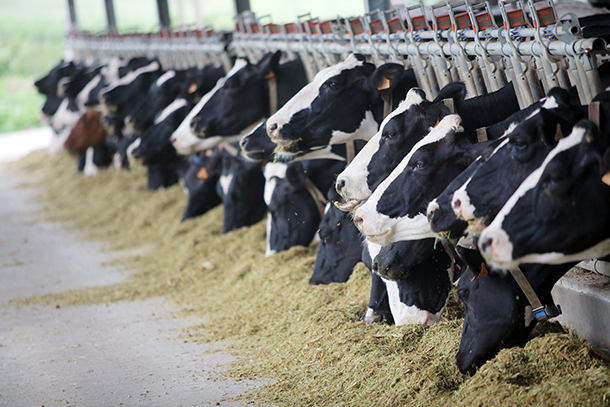
Researchers from Holland and around the world are developing a feed additive that reduces methane emissions from cows. Jake Lucas reports that the additive prevents microbes in bovine gut from making so much of the potent global warming gas.
Transcript
LUCAS: If cows were more polite, we’d have one less pollution problem to worry about. Whenever cows let loose a little gas—particularly when they burp—they emit methane, a powerful greenhouse gas. In fact, the EPA estimates that burping cattle accounted for roughly two and a half percent of the total U.S. greenhouse gas emissions in 2012.
It turns out, those potent burps come from interactions within a complex community of microorganisms in the cow’s gut. Some of those microbes break down cellulose, otherwise indigestible fibers that make up plants’ cell walls. That process produces hydrogen. Then, simple, primitive organisms called Archaea use that hydrogen and produce methane.

Now, researchers led by Dutch scientists are developing a feed additive that inhibits some of those Archaea, to reduce methane emissions from cows. So far, the team has reduced methane as much as 60%, depending on which stage of milk production the cows are in, and this new process doesn’t interfere with the cows’ digestion or how much they eat.
The next step is to make sure the additive is safe for cows, workers who deal with it, and people who drink the milk. All they need now is to work on the cows’ manners.
That’s this week’s note on emerging science. I’m Jake Lucas.