
BirdNote: Gliding with Tropicbirds
Air Date: August 22, 2014
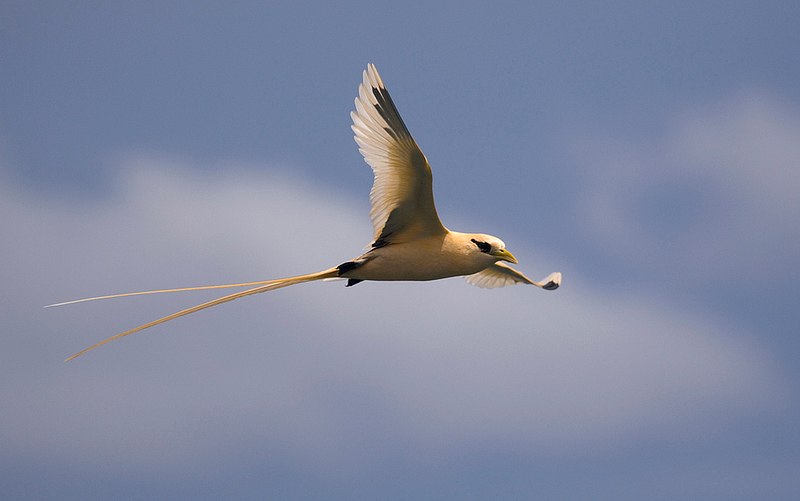
Above the sun-baked beaches of the Hawaiian islands, glistening white Tropicbirds float, with their long tail feathers streaming out behind them, as Mary McCann reports in today's BirdNote®.
Transcript
CURWOOD: It's Living on Earth, I'm Steve Curwood.
BIRD NOTE® THEME
CURWOOD: And now let's head to the sun-soaked beaches of Hawaii for today's BirdNote®.
Here's Mary McCann.
MCCANN: "Tropicbird." The name alone evokes a warm breeze and a place where green islands dot a shimmering blue ocean.
MUSIC: “Aloha Wau la Oe” by P. Cosma. Performed by the Ho’opi’i Brothers, from “Aloha From Maui”: Mountain Apple Company: 1999
MCCANN: Picture a streamlined, sparkling white seabird, with a red spear of a bill and luxuriantly long tail-streamers. With the strong, direct flight of a falcon, a tropicbird can catch a flying fish on the wing, or plunge like an arrow into the sea and—with its serrated bill—capture a squid.
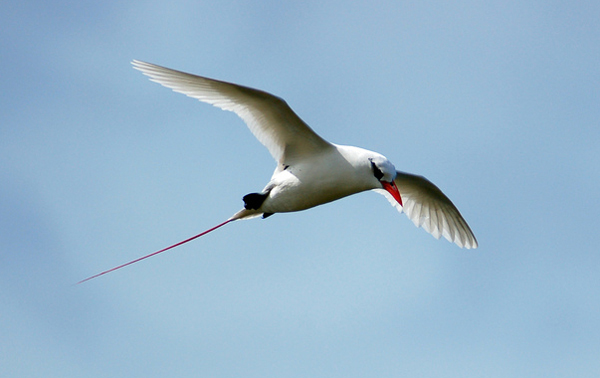
RED-TAILED TROPICBIRD VOCALS
MCCANN: Birds of such elegant natural design seem creatures of myth. And in fact, their scientific name links directly to Greek mythology, as tropicbirds belong to the genus Phaeton. Phaeton, the son of Apollo, hurtled through the sky in the chariot of the sun, only to plunge into the River Eridanus.
Myth, sun, and sea – there’s that warm ocean breeze again.
MUSIC: “Aloha Wau la Oe” by P. Cosma. Performed by the Ho’opi’i Brothers, from “Aloha From Maui”: Mountain Apple Company: 1999
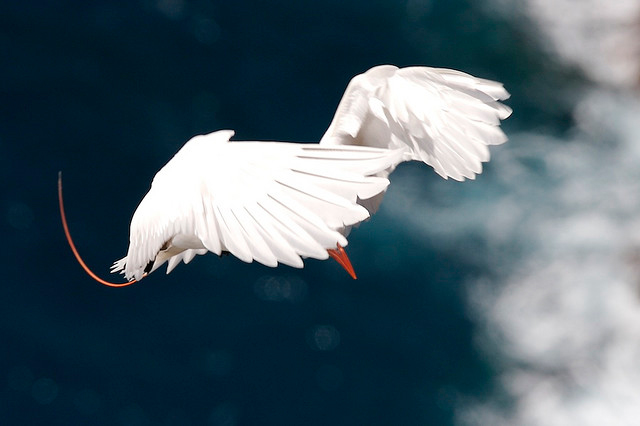
Maybe it’s time for a trip to Hawaii. Visit the island of Kauai, and you can easily see one of these near-mythical birds, its glistening white form floating in the air just beyond a sea cliff’s edge. Tropicbirds have ranged through most of the tropical latitudes of the world’s oceans for 60 million years.
I’m Mary McCann
CURWOOD: There are pictures of these magnificent birds at our website, loe.org.