
A ‘Charming’ New Particle
Air Date: November 21, 2014
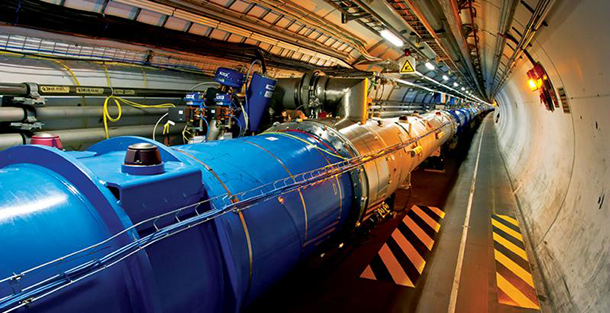
Scientists analyzing data from the Large Hadron Collider have discovered several new particles, including a couple of what are called mesons. Professor Tim Gershon of the UK’s University of Warwick, the lead author of a paper that describes this discovery, told Living on Earth’s Helen Palmer that it could help explain one of the basic forces of the universe.(
Transcript
CURWOOD: It's Living on Earth, I'm Steve Curwood. Now, we don’t often report on particle physics, but there’s a lot of news in this cosmic field. Recently, the Large Hadron Collider in Geneva found evidence of the Higgs Boson, a subatomic particle predicted years ago to partly explain how energy can become mass. And now researchers using data from the collider have discovered more new particles. Two of them are called mesons, which seem to exist for the briefest of moments as tiny subatomic particles known as quarks come together to make bigger particles like protons and electrons. This finding helps explain a fundamental force of the universe. Tim Gershon of the University of Warwick in the UK is lead author of the study in Physical Review Letters. He spoke with Living on Earth’s Helen Palmer.
PALMER: So can you describe for our listeners, in layman’s terms if you possibly can, what exactly have you found?
GERSHON: So we have discovered two new particles. These particles are of a class of particles called mesons, which means that they're composed of smaller particles which we call quarks. Quarks are among the fundamental articles of nature, you cannot divide a quark into anything smaller.
So let's imagine if we look at the world around us, and we can see a nice view, we can see trees, and trees, of course, are built of proteins that contain molecules and the molecules are made up of atoms and inside an atom is a nucleus at the center of it, surrounded by electrons. If we go closer still into the nucleus to find that is made up of protons and neutrons held together, but inside the protons and neutrons themselves we find quarks.
PALMER: So, basically you've gone as tiny as it is possible for anyone to go to look at what makes up our universe?
GERSHON: That's right. That’s right.
PALMER: So tell me about the quarks that are out there?
GERSHON: There are six types of quarks that we know about, and they are called up, down, strange, charm, top, and bottom. So the lightest ones are the up and the down, and those make up the protons and the neutrons. But the heavier ones can be produced in particle accelerators. These mesons do not exist as stable particles in nature, but can be produced in particle accelerators. The new particles that we've discovered contain a charm quark as well as another quark. They're mesons so they contain a quark and an anti-quark.
PALMER: So they're subatomic particles, but what exactly did you do to actually create these new particles not known before?
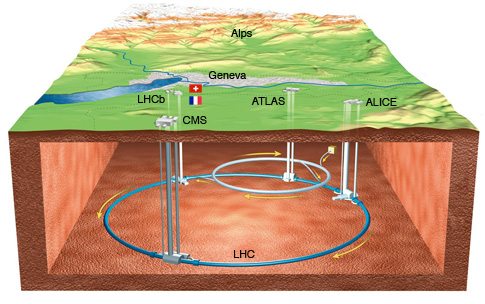
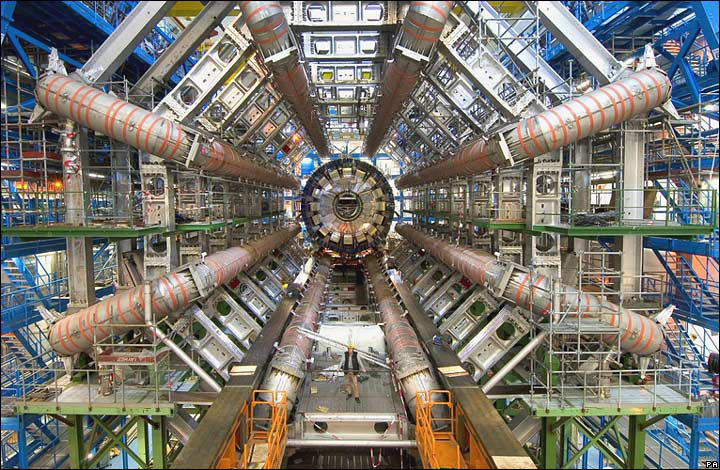
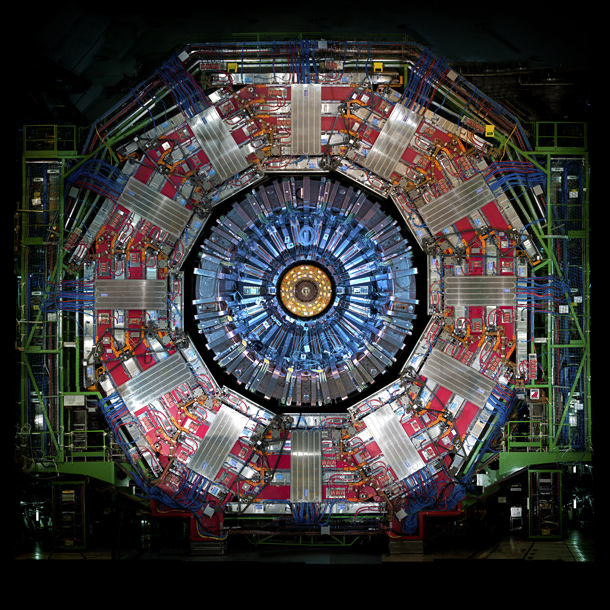
GERSHON: Well, we worked with data from the LHCB experiment at the CERN Large Hadron Collider. The Large Hadron Collider has received a lot of publicity for the discovery of the Higgs Boson. That experiment is called Atlas and CMS and quite rightly so, but there's also other experiments at the LHC and in particular the LHCB experiment is designed not to look for very heavy particles like the Higgs Boson but to understand the properties of lighter particles called B-hadrons. So the "B" here stands for bottom, which is as I mentioned, one of the six quarks. I should say that actually sometimes we call them beauty, which is perhaps a nicer name than bottom.
PALMER: Well, charm and beauty, I mean, come on. [LAUGHS]
GERSHON: Indeed. Indeed. But then, Shakesphere had a Bottom, and I suppose he had some beauty as well. Anyway, the beauty quark decays to charm. So by studying the decays of beauty quarks we can see the production of charm quarks and we can study the different types of charm meson that can be produced. Now, the quarks are bound together by the strong interaction. The strong interaction is one of the four fundamental forces of nature, that we know. The others are gravity, the electromagnetic interaction, and the weak interaction. And as the name implies, the strong interaction is very, very strong. So when you get inside a proton or a neutron, if you are able to do so, the strong interaction is the only thing that matters. All the other forces are irrelevant at that scale.
PALMER: So the strong force or strong interaction is a really vital force of nature? I mean, you spoke about the four forces. These are the forces that basically hold everything together in our universe.
GERSHON: That's right. On the cosmological scale, let's say gravity is the most important force, and gravity holds together our planet, and our solar system, and galaxies and things on a large scale like that. When we look at the molecular scale then the electromagnetic interaction is the most important, and that's what keeps electrons orbiting around the nuclei in atoms, but as we go to a smaller scale, it is the strong interaction that is the most important and takes over.
PALMER: So what you have just discovered will help you understand the strong force, which is what holds these mesons together. The weak force holds what together?
GERSHON: The weak force doesn't hold things together. So, the strong interaction holds nuclei together, but the place where people would be most familiar with the weak force is that it's responsible for causing nuclear decays. The weak interaction also has a very crucial role for processes that are going on inside the sun, for example.
PALMER: I realize that you have just added to our knowledge about about particle physics by having discovered two new ones, and it seems a little sort of like, unkind, to say are you going to find more, but are you going to find more? Are you looking for more?
GERSHON: The development that I'm really excited about is the possibility that we can use the same technique to try and study the weak interaction, and if so, this could be a great way to learn more about one of the greatest puzzles that we have, not only in particle physics, but in all of science: why the universe exists at all.
The universe is believed to have started in a big bang, essentially a ball of energy, and energy will always produce equal amounts of matter and antimatter. So at the start of the universe, there was an equal amount of matter and antimatter. But in the universe that we see around us today, we see only matter no matter how far out in space we look. And this is connected to a phenomenon that particle physicists call CP violation, but this is really just a jargon that means an asymmetry between matter and antimatter.
So we want to be able to study differences between the behavior of matter and antimatter in the laboratory, but we still haven't discovered enough different types of CP violation in order to be able to explain where the asymmetry in the universe comes from. And therefore, we're looking for for more sources, and what I'm very excited about is that we can perhaps use this technique that we've discovered these new particles with to perhaps learn more about this mystery of how the universe evolved.
PALMER: So something of some kind happened very early on that means that what we have is more matter than antimatter or we obviously wouldn't exist because if matter and antimatter basically wipe each other out, annihilate each other, then there would be no matter and there would be no stars and there would be no Earth and there would be no us.
GERSHON: That's exactly right, and what a bleak universe that would be.
CURWOOD: Tim Gershon is a Professor at the University of Warwick in the UK. He spoke with Living on Earth’s Helen Palmer.