
BirdNote: What's in a Name?
Air Date: February 10, 2017
.jpg)
Watching the birds at your feeder is a pleasure for many, but as Mary McCann comments in today’s BirdNote, identifying them can be a headache, as some as reclassified and now have new names.
Transcript
MUSIC - BIRDNOTE® THEME
CURWOOD: One of the joys of having a birdfeeder in your yard is seeing and identifying who comes to dine with you. But as Mary McCann observes in today’s BirdNote, nowadays, that can be a bit confusing.
BirdNote®
How Birds’ Names Change
Or Who Took my Rufous-sided Towhee?
Spotted Towhee trill
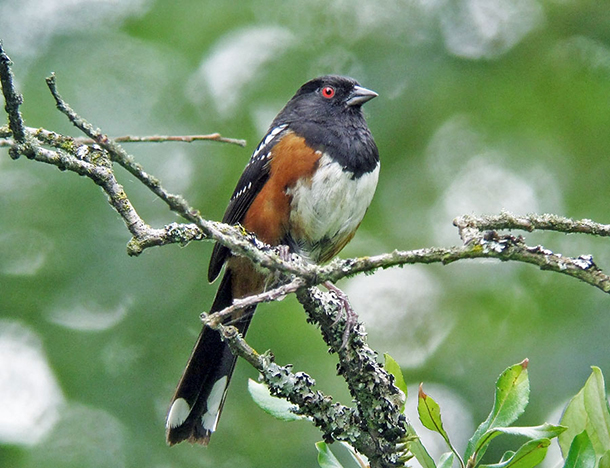
MCCANN: A listener recently wrote us: “Years ago, some of the birds at my feeder were the Rufous-sided Towhee, Oregon Junco, and Red-shafted Flicker [Spotted Towhee trill; Northern Flicker wick-wick-wick call]. But I can’t find them in my current field guides. They're gone, and so are the marsh hawk and sparrow hawk.”
American Kestrel call
Well, the listener’s right. Some of these long-familiar bird names have passed into history.
The study of birds, like any science, remains a work in progress. New findings about birds’ DNA or other attributes bring changes in classification of species, which often result in new names. Take the Rufous-sided Towhee, found across North America. Differences between its western and eastern forms – plumage, songs, genetics – brought an official split into two distinct species: the Spotted Towhee in the West [Spotted Towhee trills], the Eastern Towhee in the East [Eastern Towhee “drink-your-tea” song].
The Red-shafted Flicker, on the other hand, was lumped with the Yellow-shafted Flicker, because so many hybrids were found. Now, they all fly from tree to tree as the Northern Flicker.
Northern Flicker wick-wick-wick call
But where have the “marsh hawk” and “sparrow hawk” gone? Check your field guide for the Northern Harrier and the American Kestrel.
American Kestrel call
I’m Mary McCann.
CURWOOD: And if you like, you can flit on over to our website, LOE.org, for some pictures.