
BirdNote®: Spruce Grouse in the Boreal Forest
Air Date: December 15, 2017
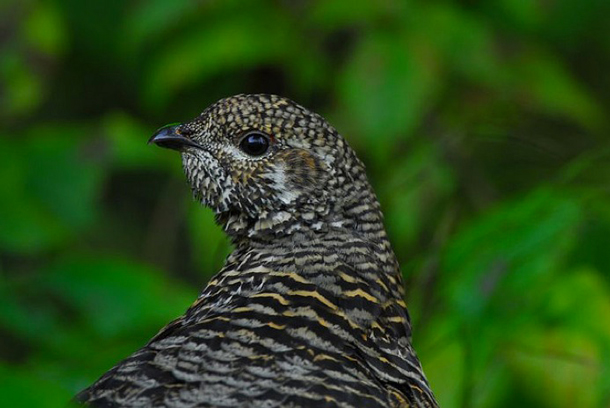
The Spruce Grouse, a plump, chicken-like bird, is perfectly adapted to the harsh landscape of the boreal forest. In this week’s BirdNote®, Michael Stein explains how the Spruce Grouse survives on an exclusive diet of pine needles.
Transcript
MUSIC - BIRDNOTE® THEME
CURWOOD: This is the time of year when evergreens move into some of our homes, and scent the air and drop needles. But as Michael Stein tells us in today’s BirdNote, out in the forest, those needles are key to survival for one special inhabitant.
http://birdnote.org/show/spruce-grouse-designed-boreal-forest
Spruce Grouse - Specially Designed for the Boreal Forest
Chill, winter wind
STEIN: In the boreal forest – the broad expanse of forest lying south of the Arctic – winter temperatures routinely drop to 30 below zero.
Chill, winter wind
Birds that spend the winter in this harsh domain of spruce, pine, and other conifers rely on remarkable adaptations in order to survive.
The Spruce Grouse is one such bird. Most Spruce Grouse – rotund, chicken-like birds that weigh about a pound – remain here all year. [Spruce Grouse clucking calls] In the snow-free summer, they forage on the ground, eating fresh greenery, insects, and berries. But in the snowy winter, the grouse live up in the trees, eating nothing but conifer needles. Lots and lots of needles. [Spruce Grouse clucking calls]
Simple enough, right? Just keep eating. But conifer needles are both low in protein, and tough to digest because they’re heavy in cellulose. To meet the energy demands of winter on needles alone, Spruce Grouse – this may seem hard to believe – grow a bigger digestive system. Their ventriculus or gizzard, which grinds food, may enlarge by 75 percent.
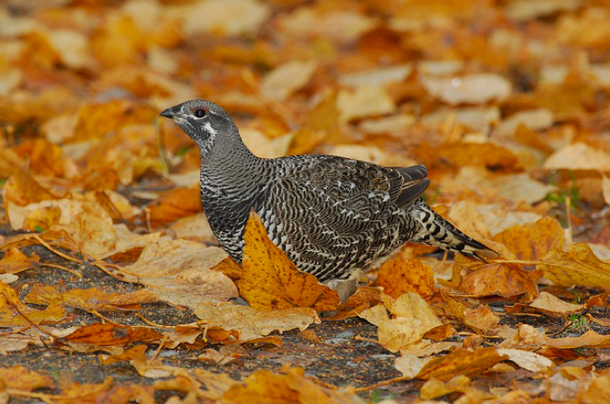
So remember the hardy Spruce Grouse this holiday season. [Spruce Grouse clucking calls] As you stand back to admire a Christmas tree, somewhere in the northern forest a grouse is nibbling away at such a tree – one needle at a time.
I’m Michael Stein.
CURWOOD: And for pictures, fly on over to our website, LOE.org.