
Extreme Weather an Extreme Risk
Air Date: January 26, 2018
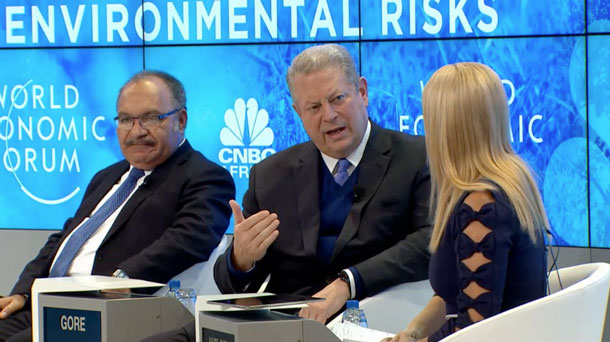
The Global Economic Forum at Davos unveiled its list of major risks facing humanity in 2018. Since extreme weather events are seen as the most likely global risks, former US Vice President Al Gore and Papua New Guinea Prime Minister Peter O’Neill urged world leaders to act to curb greenhouse gas emissions.
Transcript
CURWOOD: It’s Living on Earth, I’m Steve Curwood. Snow is normal in Switzerland in January, but on January 22nd, a 20 year record breaking blizzard blanketed Davos, disrupting travel for people heading to the annual World Economic Forum. Appropriate, then, that the category of “extreme weather events” takes the number one spot on a list made by the forum of the most likely major global risks in 2018, ahead of “natural disasters,” “failure of climate change mitigation and adaptation,” and “water crises.” And the majority of those risks are related to climate disruption. A Davos panel called “Responding To Extreme Environmental Risk” featured former US Vice President Al Gore and the Prime Minister of Papua New Guinea, Peter O’Neill – and addressed the potential of climate to derail economies, communities, and the future.
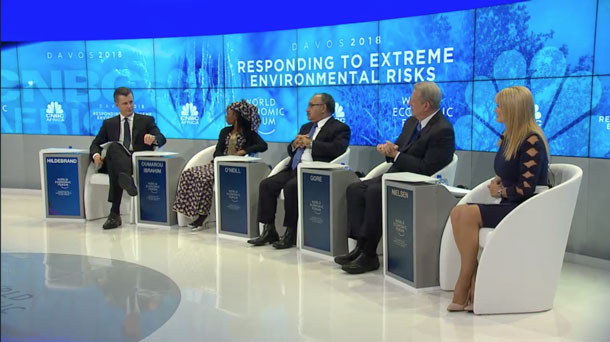
O’NEILL: The world seems to think that they’ve got time on hand. They forget to realize that there are real communities out there who are suffering as a result of these change in weather conditions. And it affects the most poorest first, and those who cannot speak. And this is the unfortunate thing about climate change, is that the most exposed are the countries with the smallest population, the smallest budgets, and the poorest families.
GORE: It is getting worse. We still have the ability to take back control of our destiny as a species, but we do not have time to waste. We need to get moving on it.
CURWOOD: Former US Vice President Al Gore, along with Papua New Gunea Prime Minister, Peter O’Neill.