
Nature and the Beat
Air Date: March 30, 2018
From the chirp of a Katydid to the screech of a parrot, the sounds of nature are all around us and now can be used to help humans make music. Living on Earth’s Bobby Bascomb reports on Beast Box, a website that allows users to create their own unique songs using catchy beats and animal calls as the instruments.
Transcript
CALLS OF A BORNEO GIBBON
CURWOOD: The howling call of a gibbon can travel up to two miles across the dense rainforests of Borneo. Many animals make some sort of sound to find a mate, warn of predators, or claim and defend their territory. And now their sounds are being used to create music. Living on Earth’s Bobby Bascomb has our story.
SFX KATYDID
BASCOMB: For many us, the staccato notes of a katydid might conjure up memories of a warm summer night, but for Ben Mirin a katydid’s chirp is music.
MIRIN: I hear music in everything.
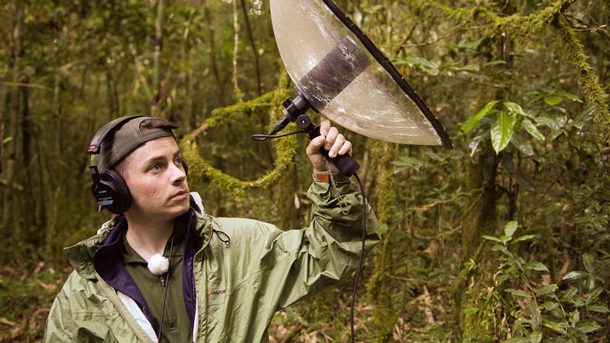
BASCOMB: Ben calls himself a Wildlife DJ. He travels the world as a National Geographic explorer to record animal sounds. And with help from the Cornell Lab of Ornithology, Ben created a website called Beast Box where users can layer animal sounds over a beat to create their own compositions.
MIRIN: I’m just a messenger for the intricately tuned voices of the natural world. And the fact that nature is always singing is really exciting to me and I hope can create similar excitement and joy in others.
BASCOMB: To make a song, users open the website and then choose one of seven beat tracks that Mirin created himself. You can choose – say, Great Barrier Reef beat…
GREAT BARRIER REEF BEAT
BASCOMB: Or Sonoran Desert Beat…
SONORAN DESERT BEAT
BASCOMB: Then select an animal sound, there are 30 of them. You can add as many as five at a time to create a song. So, let’s say you choose a coyote….
CALLS OF COYOTE IN CLEAR OVER BEAT
BASCOMB: Then an eastern whip-poor-will …
MUSIC ADDING WHIP-POOR-WILL
BASCOMB: A parrot fish …
MUSIC ADDING PARROT FISH
BASCOMB: A Hadada Ibis …
MUSIC WITH ADDED IBIS OVER BEAT
BASCOMB: And lastly a Blue Wildebeest.
MUSIC WITH ADDED WILDEBEEST OVER BEAT
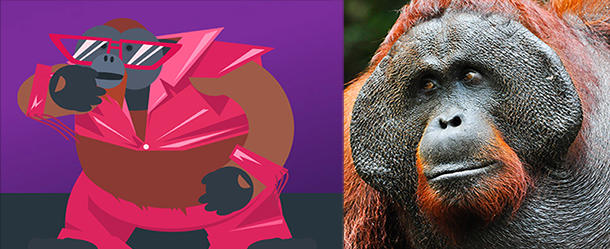
BASCOMB: Put them all together and your song is complete. On the website there’s a paragraph description of each animal and an explanation of their habitat. Each time a user chooses an animal musician, a graphic of that creature pops up on the screen and dances to the beat. For instance, there’s an orangutan in a red leather jacket and matching sunglasses.
CALLS OF ORANGUTAN WITH BEAT BACKING
BASCOMB: And a tropical Boubou wears a gold chain and a red cap.
CALLS OF BOUBOU WITH BEATS
BASCOMB: Mirin hopes beast box will be fun for anyone but the graphics and the genre of music are geared towards kids like 12 year-old Orion Brown. He says he likes playing with the website.
BROWN: I think it’s pretty cool. It’s a way to get a good education but also have some fun.
BASCOMB: For an additional challenge, users can try to put all of the animals from the same ecosystem together with the beat designed for that environment – it’s called Beast Mode. Orion chooses the Madagascar Rainforest.
BEATS OF MADAGASCAR RAINFOREST
BROWN: The first animal in that ecosystem is the Indri.
BASCOMB: Neither of us know what an Indri is. So Orion reads the description – turns out they’re lemurs.
BROWN: A small group of Indri wake up in the tree tops and begin their morning shout outs. Indri are large for lemurs with booming voices amplified by enlarged throat pouches.
INDRI CALLS
BASCOMB: Alright, what’s next in the Madagascar rainforest?
BROWN: The next one is the Lesser Vassa Parrot.
PARROT CALLS ADDED
BASCOMB: He finishes up with the Madagascar Long Eared Owl, the Red Fronted Coua, and the Souimanga Sunbird.
“BEAST MODE”
BASCOMB: So what do you think of the song you made?
BROWN: I think when you mash them up with all the ecosystems together, it sounds better, almost like it’s sort of made for the beat.
BASCOMB: So, you mean when you have all of the same ecosystem, like all of the desert or the rainforest or so together?
BROWN: Yeah.
BASCOMB: Do you think that maybe they evolved and they lived together in the same forest and making music together it comes kind of naturally? What do you think of that idea?
ORION: I think that would be a possibility and if so that would be super cool.
BASCOMB: Ben Mirin says Orion is on to something, thinking that the different animal voices complement each other.
MIRIN: Yeah, I would agree with his observation. Animal voices have evolved over millions of years to occupy different acoustic niches in an ecosystem so they don’t compete with one another.
BASCOMB: Making yourself heard is critical to surviving in nature. That’s how whales find mates across the ocean and coyotes defend their territory in the desert. Animals living in the same environment are already tuned to work well together so everyone can be heard and Mirin is excited about tapping into that existing symphony of sounds.
MIRIN: As a producer that means my instruments are already mixed. So instead of being a solo musician I get to be a messenger for the finely tuned orchestras of the natural world.
BASCOMB: Mirin says what he wants is for Beast Box to help people learn about nature and create a connection with the natural world.
MIRIN: At the end of the day, understanding and connecting with nature is critical to falling in love with it and we can’t save what we don’t love. So, I would hope that this opens a pathway for you to find your own sense of connection and love for nature so that you can be inspired to protect it, because this is a collective future we all share.
BASCOMB: Ben Mirin plans to continue sharing his recordings to foster that understanding and connection with nature. He recently returned from a trip to the Galapagos and is on his way to the Philippines next, then Honduras. So, an ecosystem from those regions could become a future beast box symphony. For Living on Earth, I’m Bobby Bascomb.
MADAGASCAR RAINFOREST SYMPHONY
CURWOOD: And there’s much more about Ben Mirin and his Beast Box at our website, loe dot org.