
Copperheads at Shawangunk
Air Date: May 25, 2018
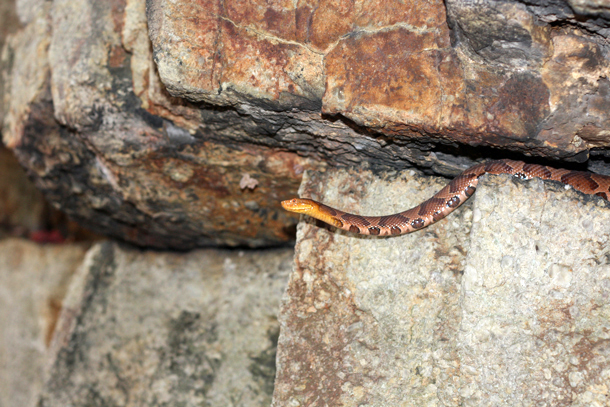
The steep blocky edge of Shawangunk Ridge towers like a fortress above a broad plain in southern New York state. The old, eroding rock of “The Gunks” provides plenty of challenges to climbers and also niches to protect small creatures, like copperhead snakes. Living on Earth’s Explorer in Residence Mark Seth Lender observes three copperheads intertwined on a stone ledge, and marvels at their languid retreat into the rock.
Transcript
CURWOOD: From wildlife refuges, we head to a protected and much loved area of New York State, the Shawangunk [SHAW-gunk] Mountains, and the Trapps, a formidable rock face. Intrepid climbers attempt to scale this vertical wall year-round. That’s not something that tempted our Explorer in Residence, Mark Seth Lender, who admits to being terrified of heights. Snakes, on the other hand, don’t bother him.
Mineral Rights
Three Copperheads at the Shawangunks
© 2017 Mark Seth Lender
All Rights Reserved
LENDER: Facing the rising sun, the Trapps are like the walls of a mythical fort, a couple of hundred vertical feet with overhangs and by and large an absence of vertical cracks. Climbing here has its risks.
Instead (like many high places) you can reach the top by trailing along the slope. And walk, and enjoy the view, and only have to contend with fear of heights instead of fear of falling.
On the northern part, where the mountain flattens out is a place where the bedrock is exposed like missing patches of hair. Stunted conifers cling there to where the stone is cracked, where they have purchase against storms. The shape – though not the stature of mature trees, they look not close but distant, a sparse and remnant forest in miniature. Between the green of the trees, from a deep crevasse, cold rolls up like invisible smoke. Even though it is summer now ice holds below.
Off the bare rock, in the leaf litter under the scrub oak, is the daybed of a black bear.
A pair of antlers lies moldering nearby where a buck dropped them the previous fall. Tooth marks of small animals mean the antlers are not going to waste. They never do.
Through the oaks and the bigger pines, and still higher on the ridge, again the mountain is scraped clean. The clean place ends in another cliff, this one looking west. From the edge, rolling valleys and lakes extend until lost in the bluish distances. Between the edge and the view a gorge dives down to a floor strewn with squared gray blocks, and the far cliff, some hundreds of feet away is the doppelganger of the near one. The force that split them apart is hard to imagine.
The morning sun is warm.
The silence profound.
Something moves…
Three copperheads lie half entwined on a shelf of stone. They are slow, and smooth, much smaller than the timber rattlers that also live up here. It is a rarity to see any of them. A tongue flicks out. The slight ssssss of scales against the hard surface. They back away very slowly and without making any threat except for the fact of their retreat. All they want is to be left alone.
At the last moment before the copperheads disappear under the ledge and into the shadows a glint of sunlight catches an eye, the iris glowing like lacquered copper, and that vertical slit in the center where light enters, but cannot escape.
CURWOOD: That’s our explorer-in-residence, Mark Seth Lender.