
The Place Where You Live: Bear Creek, WI and St. Paul, MN
Air Date: August 17, 2018
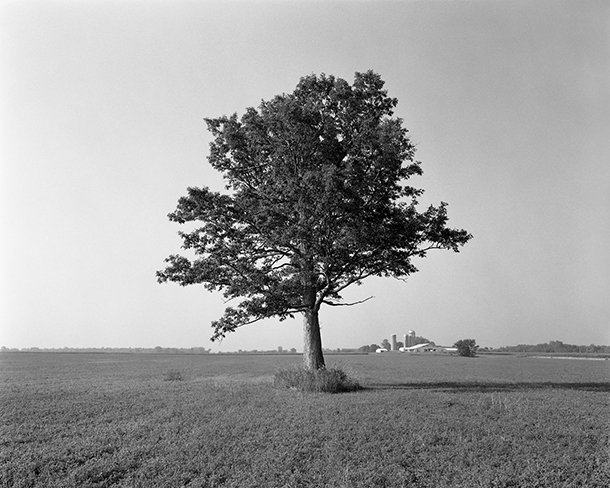
Living on Earth gives a voice to Orion magazine’s longtime feature, The Place Where You live. This week, photographer and landscape architect Regina Flanagan celebrates the special trees that humans have chosen to keep and care for in both town and country. A single white oak in a hayfield on her family’s farm in whose shade they ate lunch inspired her childhood adventures and her photography.
Transcript
CURWOOD: We take a trip now to St Paul, Minnesota and Bear Creek, Wisconsin, for another installment in the occasional Living on Earth / Orion Magazine series, “The Place Where You Live.” Orion invites readers to put their homes on the map and submit essays to the magazine’s website and we give them a voice.
MUSIC: Edward Sharpe and The Magnetic Zeroes “Home” from Edward Sharpe and The Magnetic Zeroes (Rough Trade Records 2009)
CURWOOD: A single white oak in a field near a childhood home is the inspiration for today’s essay.
FLANAGAN: I’m Regina Flanagan, and this is my essay entitled, “Lunch Tree.”
I learned much later, after my brothers had taken over the family dairy farm, that my dad called the solitary white oak in the middle of the field near the creek “The Lunch Tree.”
MUSIC: “Unfamiliar Wind,” Brian Eno, Ambient 4, EG Records 1982
Before I became a teenager and felt confined by the isolation of the farm
COWS LOWING
and thought that somehow it was keeping me from participating in the wide world outside, this landscape was my world, as it was for my dad. While I played in the hedgerows between the fields, discovering remnant patches of wildflowers, and ventured down the lane next to the woods until that exciting moment when our house was out of sight. My dad was sowing crops for the cows, corn or alfalfa hay in the broad fields.
Long before my dad farmed the land, someone had chosen to retain that solitary oak tree.
INSECTS BUZZING
It became the place where, at high noon in its shade, Dad would take a break from work, and we would eat our sandwiches and sip water from a red and white insulated cooler jug.
Now I live in a city where I find stimulation, and where I work as an artist in a neighborhood that is leafy and green and more wooded than the place where I grew up. When my siblings, nieces, and nephews from the farm visit, they are amazed by all the trees. Such diversity! Lining my street are maples, swamp white oaks, river birches, hackberries, and even a few elms. Neighbors up and down our block chip in to inoculate them against Dutch elm disease every few years, to retain their majestic canopy.
The trees along my street are here because humans decided to plant and care for them. The Lunch Tree was retained by a settler, clearing land for farming over one hundred years ago. They are all chosen trees. They endure because of human choice and care.
MUSIC: “A Clearing,” Brian Eno, Ambient 4, EG Records 1982
So, the next time you notice a solitary tree in the countryside, in an open field or along the road, you’re seeing not only a survivor of the original landscape, but the expression of a choice made long ago by people like my dad, who felt a deep affection for that place.
MUSIC AND FARM ANIMAL SOUNDS
The farm remains a working dairy farm in my family to this day, outside the village of Bear Creek, which is west and south of Green Bay. I’m a landscape architect and photographer, and I presently live in St. Paul, Minnesota. My essay is about one of my photographs, an image of a white oak, standing alone in a field of shorn alfalfa on a clear, cloudless morning. My brothers’ barns and silos are visible in the distance.
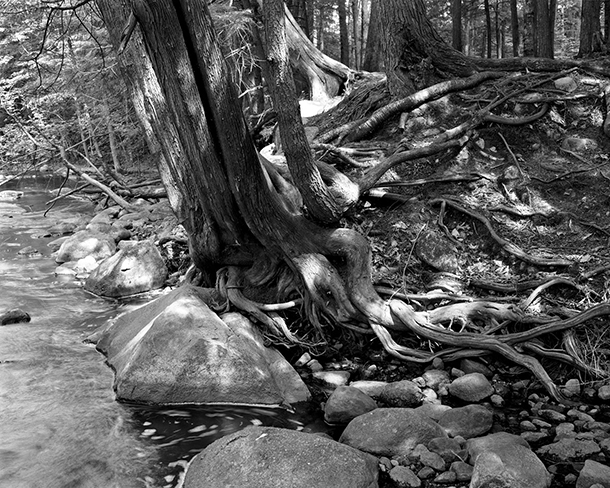
My photography is kind of the thread that connects all the pieces of my life. There are stories that a photograph can tell, but there’s also things that are not visible in the photograph and that are really about its history. The oak tree is actually a remnant of a landscape that only exists in small pieces still on the farm. That includes a small woodlot that was never logged, also an area near the creek which is where I played as a child.
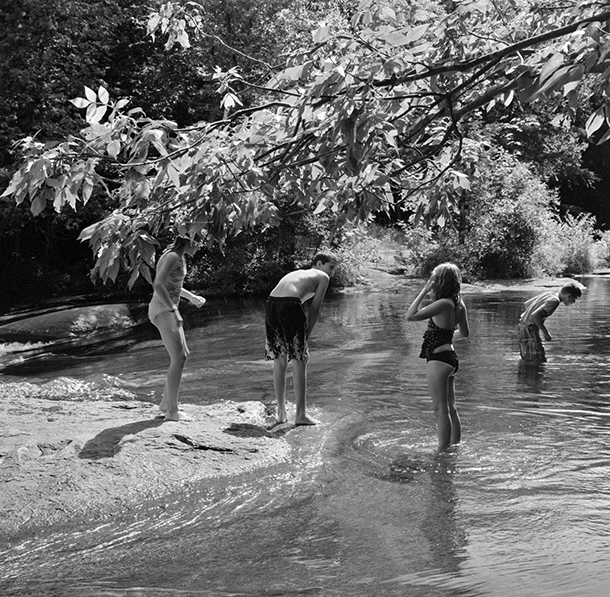
In the late 1950s and early 1960s we were sent outdoors to play, and we were often out all day. Sometimes my mom would pack me a hobo lunch, and I’d take off to have an adventure.
INSECTS BUZZING, MUSIC, WATER SOUNDS
My favorite destination was the creek down the lane, which is a cow path, really, that connected the farm fields. It was bounded by the woods on one side and on the other side by a barbed wire fence and then the fields where the cows were pastured. The woods were magical. I’d pore over the plants on the ground and the details of the leaves, their forms and shapes and occasional flowers, and I’d often wonder about the plants. What were their names and how they got there. They were the landmarks, especially the oak trees.
The sensations are still very vivid. The changes of light and shadow, the tangy smell of decaying plants in the wet meadow, and especially the trill of redwing blackbirds.
RED-WINGED BACKBIRD SONG
MUSIC: “Home,” (orig. performed by Philip Philipps) [Piano Karaoke Version], arr. Sing2Piano 2012
CURWOOD: That’s Regina Flanagan, and the Lunch Tree. There are pictures at our website, loe dot org – and there you’ll also find details about Orion Magazine and how to submit your essay, if you want to tell us about the place where you live.
MUSIC: “Home,” (orig. performed by Philip Philipps) [Piano Karaoke Version], arr. Sing2Piano 2012