
Beyond the Headlines
Air Date: January 25, 2019
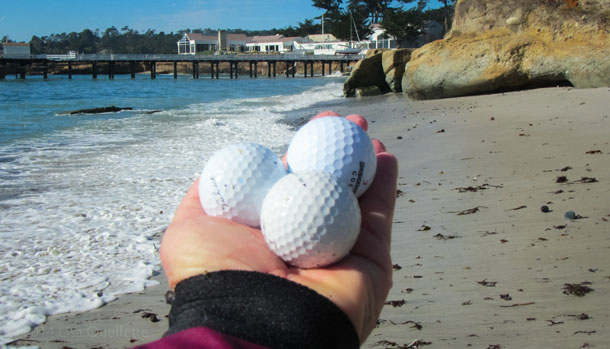
This week, Peter Dykstra joins Host Steve Curwood on a trip beyond the headlines to take a look at the work of a high school student who discovered 50,000 golf balls in the sea and shore of Monterey Peninsula. They also talk about the Government Accountability Office’s recommendation that State Dept. diplomats should be briefed on climate change. Finally, they take a look back at the 1969 Santa Barbara oil spill and how it helped spark the public’s awareness of environmental issues.
Transcript
CURWOOD: Let’s take a look beyond the headlines now with Peter Dykstra. Peter’s an editor with Environmental Health News. That's EHN.org and DailyClimate.org. He’s on the line now from Atlanta, Georgia. Hey there, Peter, what’s going on?
DYKSTRA: Hi, Steve. I want to talk about a high school science project for the ages. This is a high school junior at Carmel High School in California. With some friends she began diving and snorkeling off the Monterey Peninsula, one of the most beautiful coastal sites in the country. It's also a site of some of the most prestigious golf courses in the US. And near those golf courses, she and her friends found 50,000 golf balls along the beach, and in the shallow water offshore. The most important part of that is what's in the golf balls. They have a plastic coating that degrades into microplastics that are recognized as a serious threat to the world's water, corals, and other marine life.
CURWOOD: So, Carmel, California, that's the home of Pebble Beach. That's a famous golf course.
DYKSTRA: Yeah, Pebble Beach is the most famous of the several courses out there. Alex Weber is the name of the high school student. She got a Stanford grad student involved. Together they got their work published in a peer-reviewed journal called the Marine Pollution Bulletin. Those golf courses and their superintendents threw in an estimate that there might be twice as many other golf balls, 100,000 golf balls, just offshore.
CURWOOD: Who knew that golf was a hazard to our oceans?
DYKSTRA: It is, and maybe we should have EPA charge a two-stroke penalty for each one of those 50,000 golf balls.
CURWOOD: Hey, what else do you have for us this week?
DYKSTRA: Migration, and particularly immigration, are much in the news lately, of course. And last week, the Government Accounting Office issued a recommendation that the US brief its diplomats on climate change, something this country stopped doing a couple of years ago.
CURWOOD: Okay, climate change is of concern to, I think, all of us. Why do diplomats need a special briefing?
DYKSTRA: A big part of it is the concept of climate refugees. It's a term we hear more and more, in low lying places like Bangladesh, and even in affluent, low lying places like South Florida. People who have moved, or may soon have to move because of rising seas, more intense storms and the other impacts of climate change.
CURWOOD: Well, wait a second though, Peter. I mean, the Department of Defense, the Central Intelligence Agency, a bunch of federal organizations say that climate change can contribute to insecurity, instability for entire nations. So, what's with the State Department?
DYKSTRA: Maybe they didn't get the memo. Even though the State Department has also in the past written some memos about the risks of climate change, and particularly, that sea level rise and other impacts can cause instability to entire nations, or entire regions of the world. They should be regarded as both an international and a national security threat.
CURWOOD: Hey, what do you have from the history vaults for us?
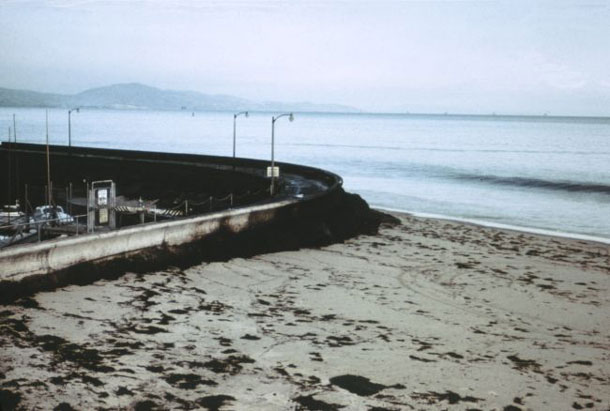
DYKSTRA: Really big 50th anniversary, January 28, 1969. There was a coastal catastrophe off the beautiful city of Santa Barbara, California. A blow out on a union oil rig just off shore. The estimates range up to 3 million gallons, not just spilled, but washing up on the beautiful beaches of Santa Barbara, and some more pristine areas both to the north and south of the city. 3 million gallons, the Gulf Oil Spill back in 2010 was 60 times as big. But because that Santa Barbara spill was near shore, and on camera, with an oily mess on wildlife and beaches, it got a huge amount of attention. That accident, along with, within the year, the Cuyahoga River catching fire and burning in Cleveland, are two things credited with inspiring the modern environmental movement.
CURWOOD: And who was Governor of California and who was President at those times?
DYKSTRA: Ronald Reagan was governor, and Richard Nixon of California was President.
CURWOOD: Ah, so the next year when the EPA gets started, maybe he's thinking of this, huh?
DYKSTRA: That’s right.
CURWOOD: Thanks Peter for taking the time with us today, we'll talk to you again real soon.
DYKSTRA: All right, Steve, thanks a lot. Talk to you soon.
CURWOOD: And there’s more on these stories at our website, LOE.org.
Related Links
- The Conversation | “A Teen Scientist Helped Me Discover Tons of Golf Balls Polluting the Ocean”
- Inside Climate News | “Climate Change Is Key Part of Understanding Migration, GAO Tells Trump Administration”
- Los Angeles Times | “The 1969 Santa Barbara Oil Spill That Changed Oil and Gas Exploration Forever”