
Climate and the Majestic Gyrfalcon
Air Date: January 25, 2019
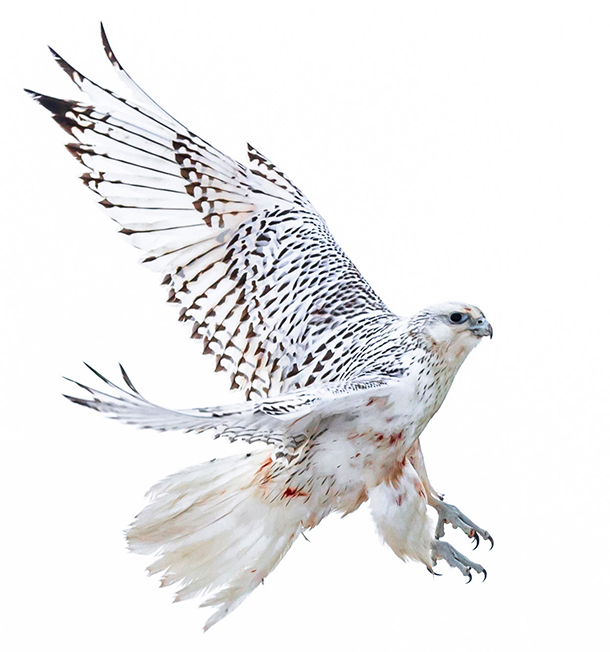
Climate disruption is bringing conflict between species that would under normal circumstances rarely encounter each other. Living on Earth’s Explorer in Residence, Mark Seth Lender, recounts a sobering encounter with a gyrfalcon injured by a rival peregrine.
Transcript
CURWOOD: Climate disruption is not only forcing people to move, it’s also changing the ranges of animals. This can lead to conflict as Our Explorer in Residence, Mark Seth Lender, found at Churchill Point in Northern Canada. There he saw two species of falcons that usually live in separate habitats meet on the frozen tundra.
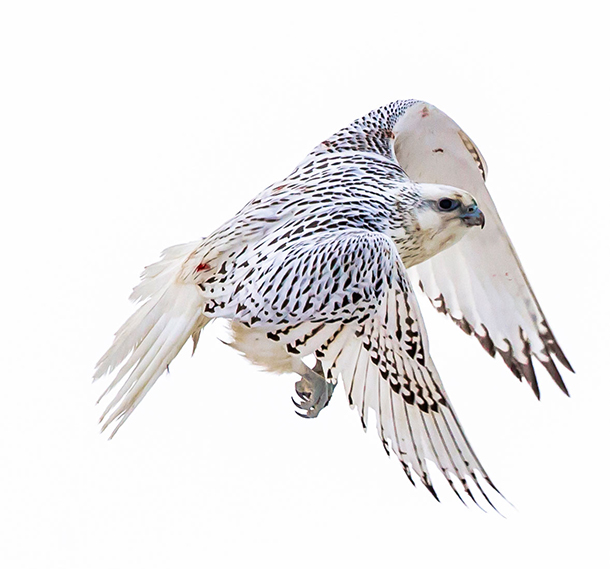
LENDER: The Arctic wind comes blade flat, fleshing the thin and the fat from the bone of the land. Freezing, the breathe in your mouth the tears in your eyes your lips, turned to match the no-color perceived of every direction. Out of which blows Gyrfalcon! He closes his wings, and holds, the grains swirling, his feathers curling, hunkered, his head tucked into his shoulders with only himself for shelter.
And lifts. And like a ghost, gone. Into the fierceness…
Moments later he fights his way back, to the same roost. And the blizzard stops just the way it started, a shallow excuse for clearing: Thirty knots ten below. A weather Gyrfalcon does not bend to. As if it were nothing. Nothing at all. Knowing, there will be worse to contend with.
Gyrfalcon ruffles, and arranges, and tucks, in his plumage in the miserly light. He cocks his head and leans far to the side. And straightens. And looks the other way. And all the way round behind him.
Searching, for what? For something to kill? What for? There is blood on his feathers already. Fresh blood. He ate. He feasted. Now should spend his time cleaning himself. But does not do so except for his feet brought up with easy balance to his beak. Then only stands there.
Recognition dawns slowly. He is not blooded. The blood is, his own.
Puncture marks laid down in groups. In twos. In threes. And the deep wounds on his back. So many. They tell a story. That he was hit from behind, low, there above his tail and that the blow drove him down. And he rolled. And laid on his back. The defensive tears on the skin of his feet tell you that, and the blood on his breast and belly also. And on his face. Meaning, the falcon went for his eyes. A peregrine, that’s all, the only one it could be. Smaller, lighter by half but fast, and his talons honed, and his eye unswerving.
Peregrine cannot be blamed for who and what he is. But this was not the work of Nature.
We did this. We have dragged the Southard North and crushed the North against itself. The peregrine should not have been here. Not when Gyrfalcon came down.
This is our result. Gyrfalcon will survive the night. But not the winter.
CURWOOD: That’s Living on Earth’s Explorer in Residence, Mark Seth Lender. For photos, check out our website, LOE.org.