
BirdNote: Exquisite Thrush Song
Air Date: August 02, 2019
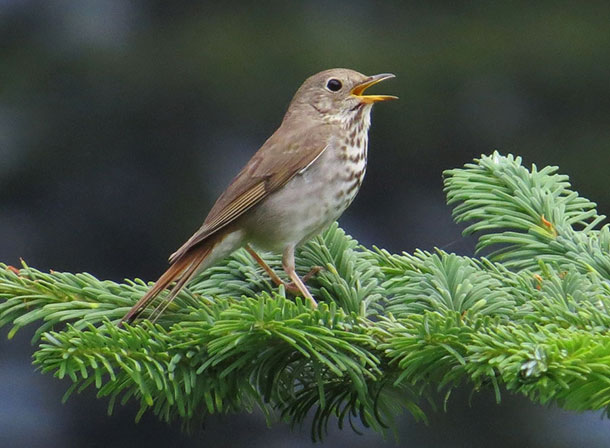
Thrushes are widely regarded to have some of the most musical bird songs. BirdNote’s Michael Stein explains how these birds use a special anatomical structure to create their elaborate songs.
Transcript
CURWOOD: In nature all creatures are beautiful in their own ways, even if we don’t always understand or appreciate them. But there is one genus of birds that has some of the easiest songs for humans to love, as Michael Stein tells us in today’s Bird Note.
Wood Thrush song
STEIN: Some believe the song of the Wood Thrush to be the most beautiful bird song in North America.
Wood Thrush song
Others select the song of the Hermit Thrush.
Hermit Thrush song
Still others name the singing of the Swainson’s Thrush.
Swainson’s Thrush
STEIN: So how do thrushes create such fine music? The answer is that the birds have a double voice box. Bird song emanates from a complex structure, unique to birds, called the syrinx. Syrinx is also the Greek word for the musical instrument we call panpipes, which have multiple pipes. It’s a fitting name for this essential part of a bird’s vocal anatomy, because, like panpipes, birds have two separate pipes to sing with. A fine singer like a thrush can voice notes independently and simultaneously from each half of its syrinx, notes which blend brilliantly as ethereal, harmonious tones.
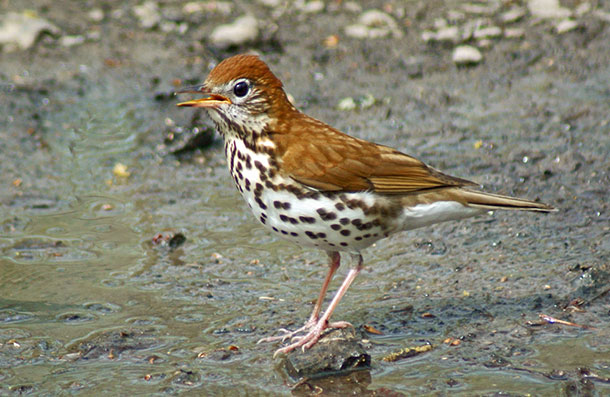
Hermit Thrush song
Fortunately for us, the results are lovely and haunting.
Wood Thrush Song
I’m Michael Stein.
Wood Thrush song
CURWOOD: For photos of these songsters, wing your way to our website, loe.org.
And by the way, the wood thrush typically migrates north to the US in Early April from wintering grounds in tropical forests from southern Mexico to Colombia. Over the past several decades, the wood thrush population has declined by 60 percent or more, with the loss of habitat cited as the major culprit. But you can still hear them today, mostly after the leaves come out in the Eastern deciduous forests.
And for your listening pleasure, here’s a longer recording of a wood thrush that Lang Elliot made on a late April day in a deep ravine in the Smoky Mountains, as part of his series Music of Nature.
Wood Thrush Song