
Rebooting Puerto Rican Power
Air Date: September 20, 2019
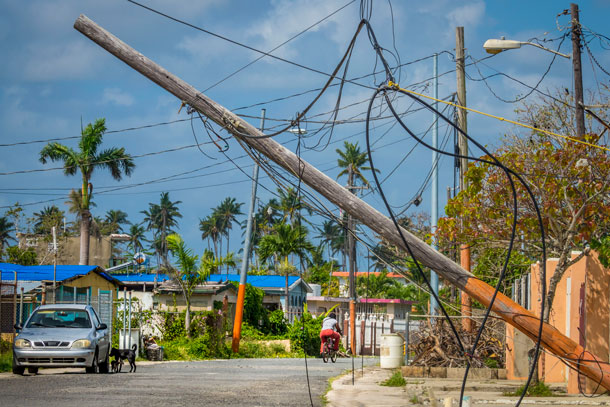
Two years ago, Hurricane Maria made a direct hit to Puerto Rico, killing thousands, destroying homes, and crippling the island’s energy infrastructure, which led to the biggest blackout in United States history when Puerto Rico’s fossil fuel-dependent grid went down. Bobby Bascomb reports on how the territory is working towards getting 100% of its electricity from renewable sources by 2050 in an effort to improve resiliency.
Transcript
CURWOOD: It’s been two years since Hurricane Maria slammed ashore in Puerto Rico, killing more than 3,000 people and leaving a trail of devastation in its wake. Among many losses, the centralized electricity grid was wiped out, meaning the entire island was without power. Before the storm more than 90 percent of the island’s electricity came from imported fossil fuels. But on a tropical island with year-round sunshine and wind, Puerto Ricans are now looking to renewables as a more resilient energy source. And the Puerto Rican government has pledged to rebuild the grid using 100 percent renewable energy by 2050. Living on Earth’s Bobby Bascomb has our story.
BASCOMB: The day Hurricane Maria hit Puerto Rico it changed the life of community organizer, Christine Nieves.
NIEVES: It felt like the world had ended, but it also felt incredibly empowering. It was the darkness of the end of the world and it was the darkness of also the beginning of something.
BASCOMB: And Christine’s way out of the darkness was through a solar powered microgrid, which was up and running at the community center within a couple months while the rest of the town was in the dark for nearly a year. The community center became a place where residents, mostly retired and living alone, were able to get out of their dark homes and meet friends, charge their phones, and cook together. I met Christine at the community center nine months after the storm where volunteers were busy preparing rice, vegetables, and meat over an industrial gas stove. But the walk in refrigerator and lights were powered by solar panels on the roof. Christine says having this microgrid setup was a game changer following the storm and she’d like to see more decentralized renewable energy on the island.
NIEVES: I think it would be good for Puerto Rico because it would be not only clean energy, but it’d be more resilient.
BASCOMB: Democratic Congressman Raul Grijalva of Arizona, chair of the House Natural Resources Committee, agrees.
GRIJALVA: I don't want the utility company, or any of the policies in PROMESA to get locked in to fossil fuels as the source for energy generation, okay? Dirty fuel is not the answer for the future of Puerto Rico. It is a diversified portfolio, alternative, renewable energy being part of it. And what I don't want to get is locked in to long term commitments on coal purchases, or any other fossil fuel generated energy source.
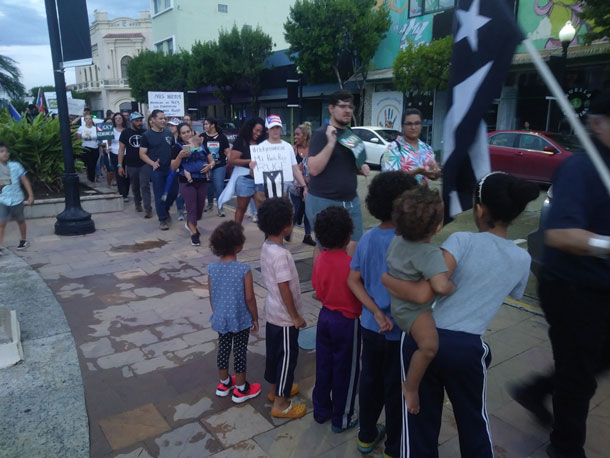
BASCOMB: Congressman Grijalva, who is a powerful member of the Congressional Hispanic Caucus, says he will soon be proposing major changes to Puerto Rico’s PROMESA law which was passed in 2016 to address the island’s debt crisis. Among the changes he will propose is the creation of a reconstruction coordinator to oversee recovery from Hurricane Maria. Mr. Grijalva says he doesn’t want to just repair the current infrastructure, but improve it.
GRIJALVA: You can't just replicate what was there because that was not working.
BASCOMB: The Puerto Rican Electric Power Authority, or PREPA, is the only electric utility on the island and has been accused of corruption in their handling of the post-Maria electricity restoration. Executives are accused of restoring power to their own homes before hospitals and airports. There are also accusations of accepting bribes, in one case from an exotic dance club, in return for a speedy response from the utility while leaving communities like Humacao waiting in the dark for nearly a year. Congressman Grijalva says there needs to be a major institutional change within the utility.
GRIJALVA: A lot of transparency needs to happen around that utility. And a lot of accountability has to happen around that utility. So we don't see it as a political dumping ground – which, accusation is that's what it has become and was. To one that is taking care of the consumer on the island, and in doing so is transparent and open about how it does its business, I think that's going to be critical too.
BASCOMB: Fernando Padilla is director of PREPA’s Project Management Office.
PADILLA: The public opinion and the public perception is that PREPA no longer serves the best interest of them. That’s why we are taking these steps forward in order to transform the company and bring in a different, a different solution.
BASCOMB: Indeed, Puerto Rico recently passed a plan to use 100 percent renewable energy by 2050, mostly from solar power. But there are plans to invest in new infrastructure for natural gas, which Mr. Padilla says is a necessary bridge fuel between the diesel, coal, and oil that fuels Puerto Rico now.
PADILLA: Natural gas brings us the elements of cost, of execution, and also the reliable power that the people of Puerto Rico need.
BASCOMB: But Marcel Castro-Sitiriche, a professor of electrical engineering at the University of Puerto Rico, says the PREPA plan has the wrong priorities.
CASTRO-SITIRICHE: Basically we need to flip around the process. First look at how much we can get with small systems in the rooftop of houses and business, and then look for utility-scale solar with energy storage, and then we see what we cannot fulfill with these two options. And we may still have to install new generating capacity with fossil fuels, but that has to be the last option.
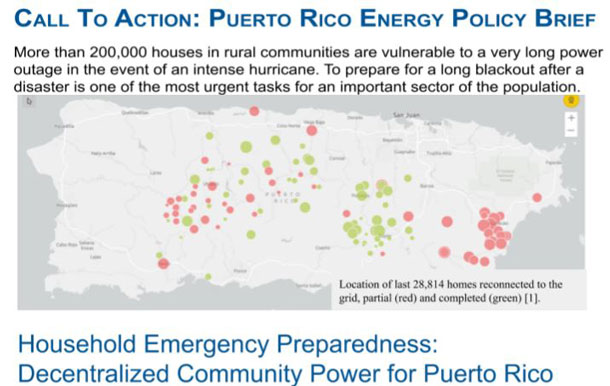
BASCOMB: Professor Castro-Sitiriche says studies suggest there is enough solar capacity on existing rooftops in Puerto Rico to power the entire island with solar. Of course, 165 mile-an-hour winds can easily rip the solar panels off a roof, but Castro-Sitiriche says that’s yet another reason to invest in this type of distributed energy.
CASTRO-SITIRICHE: Because, for example, if you have a small solar system of six to eight panels on your house, it is reasonable to arrange for two healthy adults to bring those panels down before the hurricane.
BASCOMB: And then easily put them back up after the storm passes.
CASTRO-SITIRICHE: If we start from the bottom up, then we start building more distributed resiliency into the communities.
BASCOMB: And that need for resiliency is something that nearly everyone in Puerto Rico can agree on. For Living on Earth, I’m Bobby Bascomb.
CURWOOD: We’ve assembled the stories Bobby reported from Puerto Rico into a special feature on our website. Please check it out at LOE dot org.