
BirdNote®: Red-Necked Phalaropes, Spinners On The Sea
Air Date: October 25, 2019
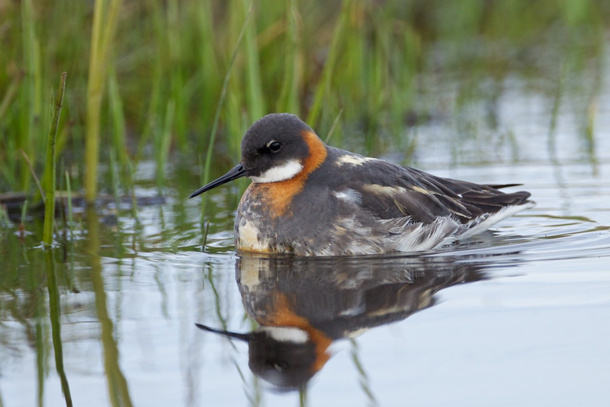
Some birds catch their food on the wing, snatching insects out of the air or plunging for fish in water. Others peck at trees or the ground to find grubs and worms but as BirdNote’s Michael Stein reports, an Arctic bird called the red-necked phalarope has a more unusual way to collect its dinner.
Transcript
DOERING: Some birds catch their food on the wing, snatching insects out of the air or plunging for fish in the water. Others peck at trees or the ground to find grubs and worms but as BirdNote’s Michael Stein reports, one Arctic bird has a more unusual way to collect its dinner.
BirdNote®
Red-necked Phalaropes, Spinners on the Sea
[Calls of Red-necked Phalaropes and sound of wind on the ocean]
Red-necked Phalaropes are sandpipers that make their living from the sea. They breed on the arctic tundra but then migrate to the open ocean, where they’ll stay through the winter, feeding on tiny crustaceans and other marine animals.
You’ll be lucky to ever see one of these little birds, but if you do it’ll probably be on a shallow arctic lake. Stay and watch for a bit and you may see the phalaropes’ wonderfully unique method of feeding.
The birds twirl on the surface like little ballerinas, spinning and pecking, again and again.
[Calls of Red-necked Phalaropes]
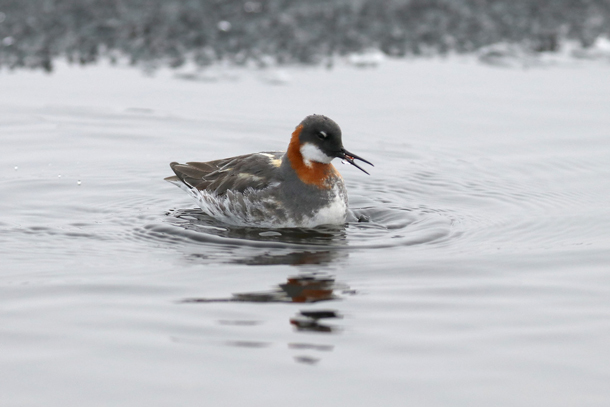
As it spins, the phalarope forces water away from the surface, causing an upward flow from as deep as a foot below. And with this flow comes food. Little animals, like tiny fly larvae, are forced to the surface. Then the phalarope quickly opens its bill, creating another rapid movement that pulls its prey into the back of its mouth.
One of the rewards of observing birds closely is that you see the fascinating strategies they use to survive and thrive.
[Calls of Red-necked Phalaropes]
###
Written by Dennis Paulson
Producer: John Kessler
Managing Producer: Jason Saul
Editor: Ashley Ahearn
Associate Producer: Ellen Blackstone
Assistant Producer: Mark Bramhill
Narrator: Michael Stein
Bird sounds provided by The Macaulay Library at the Cornell Lab of Ornithology, Ithaca, New York. Recorded by G. Vyn. Ambient sound by Kessler Productions.
BirdNote’s theme music was composed and played by Nancy Rumbel and John Kessler.
© 2019 Tune In to Nature.org September 2012 / 2015 / 2019
https://www.birdnote.org/show/red-necked-phalaropes-spinners-sea
DOERING: For pictures, spin on over to our website, loe dot org.