
BirdNote®: Left Foot or Right? Handedness in Birds
Air Date: February 21, 2020
More than three quarters of humans are right handed, regardless of culture or where we live in the world. Scientists haven’t really figured out why our species has such a dominance for right handedness but they have found a similar preference in other species. BirdNote®’s Michael Stein reports.
Transcript
CURWOOD: It’s Living on Earth, I’m Steve Curwood.
BIRDNOTE THEME
CURWOOD: More than three quarters of humans are right handed, regardless of culture or where we live in the world. Scientists haven’t really figured out why our species has such a dominance for right handedness but they have found a similar preference in other species. BirdNote’s Michael Stein reports.
BirdNote®
Left Foot or Right? Handedness in Birds
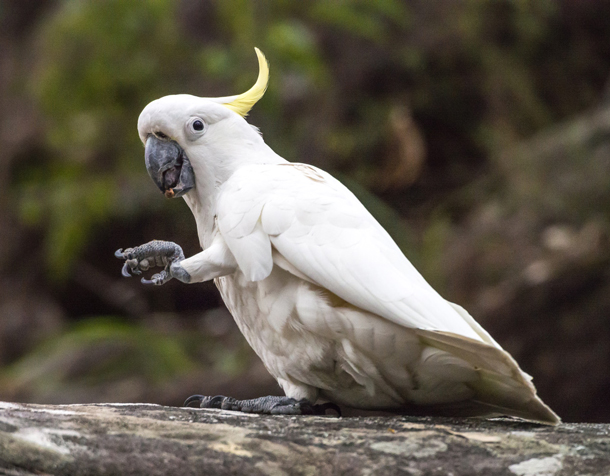
Imagine you’re about to shake hands, but with a Sulphur-crested Cockatoo.
Should you offer your right hand or your left?
You should hold out your left hand. That’s because most Sulphur-crested Cockatoos are left-footed.
In complex tasks like manipulating a piece of fruit, these intelligent birds work intently with their feet. A parrot’s eyes are located on the sides of its head. So, if it wants to look at something -- say, a delicious piece of fruit -- it has got to cock its head one way or the other do it. And if it looks with its left eye, then uses its left foot.
Scientists call this handedness. That’s when one hand — or foot — is used consistently over the other for doing more complex tasks.
In a study of 16 Australian parrot species scientists found that about half were lefties, a third were righties, and a few were neither.
Handedness, once thought unique to humans, is also seen in chimps and gorillas — mostly righties — and orangutans — mostly lefties, as well as cats and kangaroos.
The evolution of handedness, for righties and lefties alike, improves skill and efficiency in complex tasks—for both parrots and for humans.
###
Written by Bob Sundstrom
Bird sounds provided by The Macaulay Library of Natural Sounds at the Cornell Lab of Ornithology, Ithaca, New York. Recorded by V Powys ML234725.
BirdNote’s theme music was composed and played by Nancy Rumbel and John Kessler.
Producer: John Kessler; Managing Producer: Jason Saul; Associate Producer: Ellen Blackstone
© 2019 Tune In to Nature.org February 2019/2020 Narrator: Michael Stein
ID# handedness-01-2019-02-07 handedness-01
CURWOOD: For pictures of these birds, fly on over to the Living On Earth website, loe.org.