
A Preschool Christmas Bird Count
Air Date: April 10, 2020
Susan Edwards Richmond’s new children’s book, Bird Count, follows a young citizen scientist as she participates in a Christmas Bird Count, the 120-year-old census of winter birds conducted by teams of volunteers for the Audubon Societies. Living on Earth’s Bobby Bascomb visited the author and the preschoolers she teaches at Massachusetts Audubon's Drumlin Farm for a day of birding, and a discussion on the importance of citizen science. Hijinks, and a whole lot of learning, ensued.
Transcript
So we thought we would check out the Christmas Bird Count at the Massachusetts Audubon Society, which has been hosting one since 1900, even before the National Audubon Society was formally established in 1905. The key notion is to count every bird you see in the course of a day in a particular area. Many consider it to be the largest citizen science project in the world with close to 80,000 people expected to participate this year between December 14th and January 5th. And now there is a children’s book about the Christmas Bird Count, written by Mass Audubon’s pre-school teacher, Susan Richmond. Living on Earth’s Bobby Bascomb met up with Susan and some of her students at Mass Audubon’s Drumlin Farm in Lincoln near Boston to do a bit of birding and check out her book.
SOUNDS OF KIDS AT CIRCLE TIME
BASCOMB: Susan Richmond is seated in a wooden child sized chair in front of a massive stone fireplace. Her 13 preschool students fan out in front of her in a half moon as she reads from her book…..
SOUND OF PAGE TURNING
RICHMOND: I shake mom in the dark. Wake up sleepy head, it’s bird count day!
BASCOMB: Her story follows a little girl named Ava out on a bird count with her mom and their group leader Big Al. The book goes over the basic rules. Each bird has to be seen by at least two people, you can’t count the same bird twice, and you must keep a tally of the birds you see as you go.
RICHMOND: Our team follows the same route every year. Fields, woods, wetlands, neighborhoods, even the center of town. A chickadee calls good morning. Chic-a-dee-dee-dee. I add it to the list, I’m going to be busy today.

KID SOUNDS
BASCOMB: Once they finish the book the kids have a snack and get ready to go outside and I chat with Susan about her inspiration for the book.
RICHMOND: I am a passionate birder, like, I love birding. So it was sort of a natural topic for me. I think one of the reasons that I love birds so much is because they are everywhere. I mean, even the city, you can count starlings and house sparrows and the occasional peregrine falcon or you know, maybe you will find something like a song sparrow, but it doesn't matter. Like every bird is important. It's really this treasure hunt. It's very exciting.
BASCOMB: With 120 years of data from across the Western Hemisphere, the Christmas Bird Count has yielded a massive data set that already documents changes in bird distribution.
RICHMOND: So it's become a really valuable tool for ornithologists to study all kinds of things, effects of climate change on bird populations, as well as development, pollution and all kinds of other factors. I mean, they have definitely seen, been able to track things like the birds that used to be only in the southern part of the United States, for example, I mean, people don't understand that a cardinal actually used to be a southern bird. Now it seems sort of the quintessential Christmas bird against the snowy background on the Christmas card. But actually, they used to be, I can't tell you how many years ago but they were typically a southern species. So we've seen that that in response to changing climate patterns.

BASCOMB: In the North, winter is a good time for novice birders to get out and look for birds. There are few migrating birds around to misidentify.
RICHMOND: Most of the birds that you're going to see in the winter are the resident birds that you see all year. So, you know, you might occasionally see something unusual like a snow bunting or a Ruby crowned kinglet or something but hopefully there might be someone on the team who can help you with that.
BASCOMB: Huge surveys like this wouldn’t be possible without volunteers, so citizen scientists are a valuable resource. Plus, birding is great way for children to engage with nature.
RICHMOND: I feel like the most important thing to do at this age, at the age of three, four or five or two, is to have them connected with their immediate environment, to love not just nature as an abstract concept or love seeing beautiful pictures of nature but actually love their environment and, and become invested in it and care about it because that's what's going to make them want to protect it when they grow up.
SOUNDS OF KIDS GETTING DRESSED TO GO OUT

BASCOMB: Snack time is over for the children so they suit up and head outside. Donning rubber boots, brightly colored rain pants and jackets the kids head out into an unseasonably warm December day.
KIDS TROMPING OUTSIDE
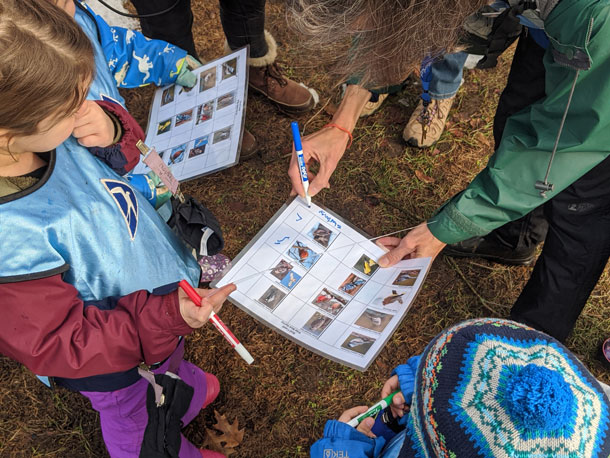
They are armed with a laminated page showing pictures of the dozen birds we are likely to see and a dry erase marker so they can mark them off.
CRUNCHING THROUGH SNOW / SPLASHING THROUGH PUDDLES
BASCOMB: The kids crunch through what’s left of a recent snow and stomp in mud puddles. Before long…
RICHMOND: I did hear a chick-a-dee-dee-dee, did anyone hear that?
KID 1: Mm-hmm.
KID 2: Me too!
RICHMOND: So you can make a mark, because we heard it.
KIDS STOMPING THROUGH SNOW, PUDDLE SOUNDS
BASCOMB: Hi! What kind of bird do you want to see today?
DANNY: A… blue jay.
BASCOMB: A blue jay? Why do you want to see a blue jay?
DANNY: Um, because… um, I like how they fly.
BASCOMB: Some kids are poking around in the snow and mud while others strain their eyes and ears for birds.
TEACHER: House sparrows, yes! Three house sparrows over there. And Milo saw them too, so that means we can add them, because two people saw them.
BASCOMB: But it’s not always easy to identify birds from a distance.
RICHMOND: Oh, I do see them! Friends, come over here, I see some birds in trees. It’s hard to tell what they are… big black birds.
LEO: Crows!
RICHMOND: They, they could be crows, Leo; they look, I don’t know if they’re big enough for crows.
KID: I think they’re a kind of hawk.
RICHMOND: Hmm. . . . Ah. I think they’re starlings. Which is not on our list, but we can add them. Shall we add them, Danny?
DANNY: Yeah.
KID: Can you add it to mine, too?
RICHMOND: Sure. Starlings… ‘cause starlings are all black.
KID: Can you add a starling to me?
RICHMOND: Mmhmm. And we saw two, two starlings.
BASCOMB: And then, a chance to visit birds of a different feather.

ROOSTER CROWS / HENS CLUCKING
BASCOMB: Drumlin farm is home to dozens of chickens, of many different breeds. And today the children have to do their chicken chores in the hen house. They collect any eggs the hens have laid, and make sure they’re well-fed. A few are afraid of the loud sounds but most kids are jostling to feed the fowl.
RICHMOND: Theo, Benjamin, Rivka, do you want to feed the chickens? Let me give you a little food.
SOUND OF FOOD PELLETS
HENS CLUCKING IN BACKGROUND
RICHMOND: Did you find any eggs?
KID: One’s still laying eggs so we have to wait to get ‘em.
RICHMOND: Okay, let’s go on to the next one. Can you put your container back? Thank you.
SOUNDS OF KIDS TROOPING OUT OF THE HENHOUSE
BASCOMB: Soon the flock of preschoolers heads back up the path.
SOUNDS OF GROUP WALKING ON THE PATH
BASCOMB: Today’s birding has been an informal session, kind of a practice run. But I asked the kids if they would like to do a real Christmas Bird Count like Ava in the book.
KIDS: Meeeee!!
KID: I do!
BASCOMB: Why do you want to do one?
KID: ‘Cause it’s so fun!
BASCOMB: Yeah, what’s fun about it?
KID: Um, the birds!
BASCOMB: Seeing the birds? Did you say you want to do one, Danny? What do you think, what would be so fun about it?
DANNY: Um, because I like birds.
BASCOMB: What do you like about birds?
DANNY: Um, that they have soft feathers.
BASCOMB: The national Audubon’s Christmas Bird Count takes place December 14 through January 5. There are roughly 2500 events listed online, probably one near you, and it’s fun for the whole family.
KIDS PLAYING IN THE SNOW, HAVING FUN
BASCOMB: For Living on Earth, I’m Bobby Bascomb in Lincoln, Massachusetts.
CURWOOD: Our story about the Christmas Bird Count was produced by Jenni Doering with help from Isaac Merson.
KIDS PLAYING IN THE SNOW, HAVING FUN