
Note on Emerging Science: The Days the Earth Stood Still
Air Date: May 01, 2020
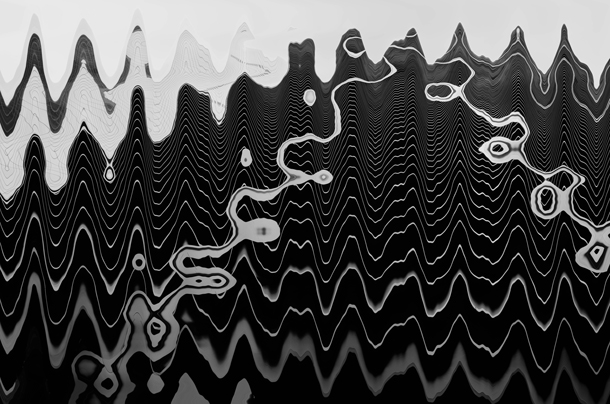
As people around the world self-isolate and non-essential work is put on hold, the Earth has grown quieter. Seismographic data show that ambient vibrations caused by human activities, have decreased by 30 to 50% since stay-at-home orders went into effect. Living on Earth’s Isaac Merson reports.
Transcript
CURWOOD: Just ahead, many zoos and aquariums have had to close their doors but they’ve opened an online window. But first this note on emerging science from Isaac Merson.
SCIENCE NOTE THEME
MERSON: As people around the globe shelter at home, an unusual calm has come to the surface of the earth.
In fact, our reduced activity and physical movement can actually be measured using seismographs, instruments used to measure the minute movements of the earth beneath our feet.
Seismographs are extremely sensitive. They sense vibrations caused by sources as varied as the wind moving across the surface of the earth, the crash of waves on the shore, the hum of pressure as gasses bubble up through cracks and seams in the crust in the earth.
And they also detect vibrations caused by human activities, such as the movement of vehicles or the pounding of industrial machinery.
MACHINERY SOUND
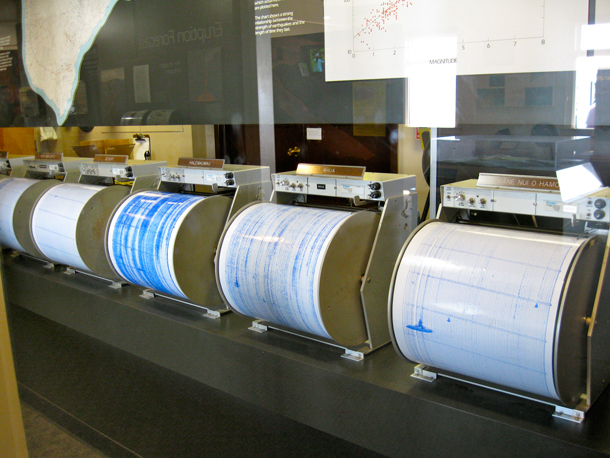
All these vibrations create a background which can be hard for earth scientists to tease apart.
But in the weeks since governments have issued orders to stay at home Seismograph data from around the world has shown a tremendous decrease in the amount of these ambient seismic vibrations.
One seismograph located at the Royal Observatory of Belgium showed a greater than 30% decrease in the total background vibrations in the weeks since Belgium instructed its citizens to stay home.
And Brussels isn’t alone. Seismographs from Los Angeles, London, and Barcelona have shown similar or even larger reductions.
Now, in the absence of some of that muddy background data, scientists may be able to gather important information about the influence of other sources of ambient vibrations, such as the exact contribution of the oceans.
OCEAN SOUNDS
This may help us better predict future earthquake events, especially in highly populated urban areas.
In the meantime, the relative stillness of the earth’s crust could allow seismologists to better detect seismic events happening right now,
EARTHQUAKE SOUND
as the signal may come through more clearly with less competing noise, like a radio signal with less static.
For Living on Earth, I’m Isaac Merson.
SCIENCE NOTE THEME
