
Sap-Iens: Yellow-Bellied Sapsuckers
Air Date: May 01, 2020
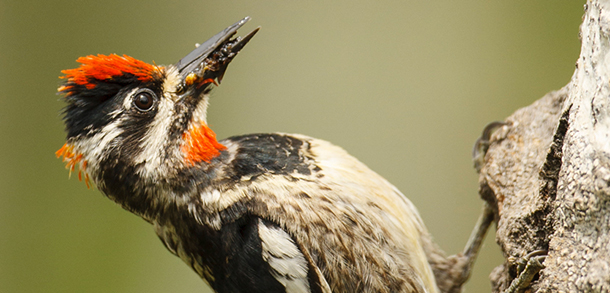
In the far North, the short season for raising young means nesting birds have to work fast. Living on Earth's Explorer in Residence, Mark Seth Lender, marvels at the speed and diligence with which a pair of yellow-bellied sapsuckers build and maintain a nest.
Transcript
BASCOMB: Spring is, of course, a busy time for birds. Once they’ve finished their migrations it’s time to get down to the serious business of finding a mate, building a nest, and raising chicks. As our Explorer in Residence Mark Seth Lender found in Lake Logan, British Columbia the short season for raising young in the far North means birds there have to work fast.
Sapiens
Yellow-bellied Sapsucker
Lake Logan, British Columbia
© 2020 Mark Seth Lender
All Rights Reserved
He is working as fast as he can. Hammering reshaping creating space, where there was none. Works as hard as he can. Rest is not his friend nor time North of a rigid line wherein a good year spring and the incipient chill of winter is no more than sixty days apart, everything doing is done with a start.
There are already young in the nest and them… will not… wait.
Yellow-bellied Sapsucker, in the season when life renews itself and the world again is green, never gets to sit on the shelf. Leisure? Not for him, not for the one who is his mate. At her own hectic pace shuttles back and forth, forth and back with insects in her mouth. Today’s special ants by the baker’s dozen, their armor burnished and shimmering. She squeezes (groceries and all) into the opening that is perfectly round and perfectly small to feed a colony of her own.
Then out.
Then off.
Again, for something else.
Between these winged deliveries, Yellow-bellied Sapsucker tucks inside, craftsman, designer, laborer all in one. Minutes later shows his face, beak as full of sawdust as it can be, grains falling the length of the tree. Then off and away to hide the telltale signs of all he has done, all his colors flashing - black white deep crimson yellow - as if illumined by the final glow of the sun.
Though the day is less than halfway.
And will end too soon.
And not soon enough.
The baby birds grow and grow at an exponential pace. He wants to stop he wants to work and needs to sustain himself, all three in contradiction. But there it is. The builder inside him always wins. That is his way. He is responsible. The future depends on him.
This he knows. His persistence tells you so.
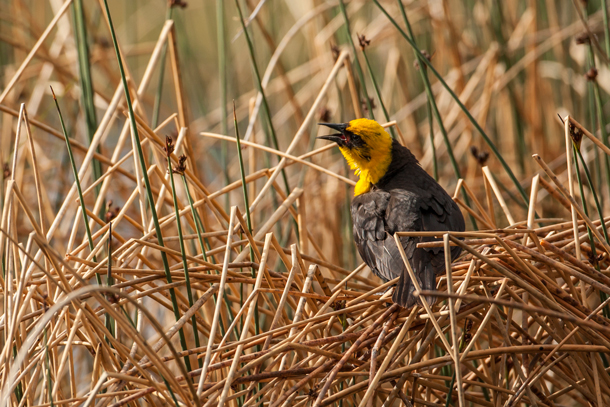
Orchids are flowering under the pines, and in the open field stands of wildflowers host the urgent dance of fritillaries bartering for nectar in exchange for the pollen that they bring. The song sparrow and the sparrow hawk conjoin in an unequal embrace. A yellow-headed blackbird lands calling his throaty call, the cattails swaying under him. Marsh wrens bend cattail leaves into a basket that will be their homestead. The lynx crosses the shallow stream, his round wide paws barely splashing. He climbs the bank that is low but steep and into the trees.
At a distance, a moose and her calf watch the lynx retreat, wary, weary for all that the coming seasons will demand.
Inside the yet unfinished nest, Yellow-bellied Sapsucker closes his eyes and for a brief while, without having to spread his wings, takes flight.
BASCOMB: That’s Living on Earth’s Explorer in Residence, Mark Seth Lender. For photos from Mark’s trip head over the Living on Earth website, LOE.org.