
Beyond the Headlines
Air Date: July 03, 2020

This week, Environmental Health News Editor Peter Dykstra and Host Bobby Bascomb discuss the politicization of the public health practice of wearing masks. Then, the oil and gas industries face major contractions as countries impose travel restrictions to slow the spread of the coronavirus. Finally, Peter and Bobby take a look back at shark, sewage and medical waste scares along the New Jersey coast.
Transcript
BASCOMB: It's time for a trip now beyond the headlines with Peter Dykstra. Peter's an editor with Environmental Health News--that's ehn.org and dailyclimate.org. Hey there, Peter, what do you have for us this week?
DYKSTRA: Well, hi Bobby, you know, and all the political swirl and the blanket coverage of coronavirus and the economic impacts of coronavirus. We've also gotten an opportunity to watch a twisted cousin of climate denial take hold. Disease denial, COVID-19 denial, whatever you want to call it, has people out there that view not wearing a mask in defiance of state orders as an act of patriotism. And in states like my own state, Georgia, Alabama, Florida, Texas, states that have reopened their societies too quickly, are now seeing COVID deaths and diagnoses increase,
BASCOMB: Right, it's really strange, but somehow wearing a mask or not has become a political statement. And now Just a prudent health measure. But of course the virus doesn't discriminate if you're a Republican or a Democrat. Well, what else do you have for us this week, Peter?
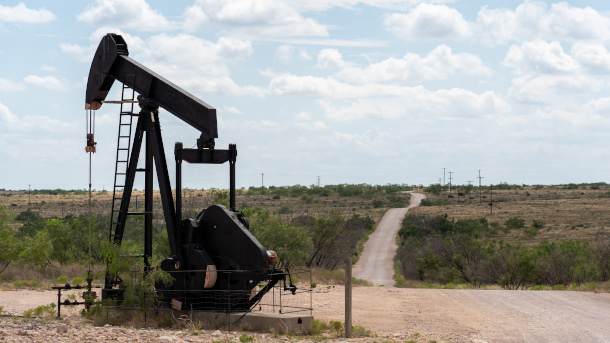
DYKSTRA: Something that was pointed out to me by an article in the online magazine Quartz, oil and gas companies may be set to lose a trillion dollars or more in revenues. This year, the oil and gas industry, including all of the major oil companies, made 2.47 trillion in revenues last year, in 2019. This year, it by some estimates may be only a trillion, or maybe a trillion and a half, which gets to be real money.
BASCOMB: Hmm. So they've lost about half their value?
DYKSTRA: Possibly as much as half their value. Contrast that to a company like Apple. Apple's worth about a third of a trillion. They haven't passed the oil and gas industry yet, but the momentum for both is clear. Oil and gas is slowly dying off and software companies are constantly growing. And at some point, Apple is going to catch up to Exxon Mobil, BP, Texaco, and all the other companies that have driven not only our economy, but our international policies for almost literally the last century.
BASCOMB: Hmm. Well, you're comparing apples to petroleum here, though. I mean, how fair is that? Really?
DYKSTRA: There's a zinger for you, Bobby. It may be very, very fair in the near future. And it's something we'll be looking for. The clean energy sector, wind and solar, they've got a much, much longer way to catch up to oil and gas, but the momentum is clear.
BASCOMB: All right. Well, what do you have for us from the history books this week?
DYKSTRA: We're gonna do a special Jersey edition in honor of my home state, and go back to 1916. The US hadn't even entered World War I yet, but there were attacks along the Jersey shore, specifically by sharks against humans. And 60 years later, that string of attacks that terrorized, much of the East Coast and certainly New Jersey became the inspiration for Peter Benchley's book, and the movie Jaws, one of the biggest, most successful movies of all time.
BASCOMB: Yeah, that one's still frightens people, I think to some degree or certainly has given sharks a bad reputation in pop culture.
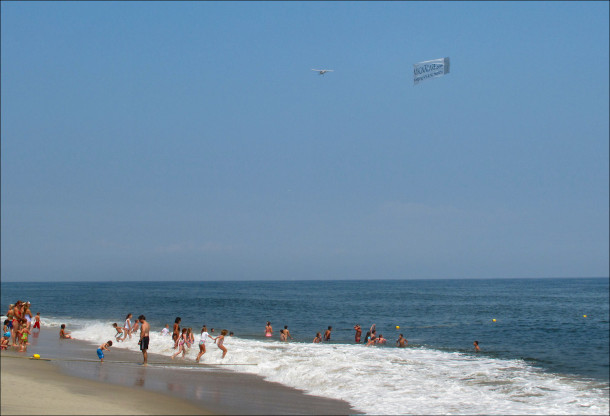
DYKSTRA: Sharks have some really bad PR, but so did New York City for dumping sewage sludge off the Atlantic coast. They formally ended that practice on June 30, 1982. Fast forward to five years later, medical waste started washing up on the beaches of New Jersey that lasted through the 1988 summer season. And it became an impetus to better enforce and strengthen ocean pollution and water pollution laws around the country.
BASCOMB: Wow. 1982 and 88. I mean, that's not that long ago to be dumping medical waste and raw sewage into the ocean off one of the most populated cities in the country.
DYKSTRA: Right? And if you consider that 1988 was when James Hansen really sounded the alarm that the public first heard about climate change. And, look, we're here 32 years later, and climate denial, along with coronavirus denial, still sits in the White House.
BASCOMB: All right. Well, thank you. Peter. Peter Dykstra is an editor with Environmental Health News. That's ehn.org and dailyclimate.org. We'll talk to you again real soon.
DYKSTRA: All right, Bobby. Thanks a lot, talk to you soon.
BASCOMB: And there's more on these stories on the Living on Earth website. That's loe.org.