
BirdNote®: The Oilbird’s Lightless Life
Air Date: January 08, 2021
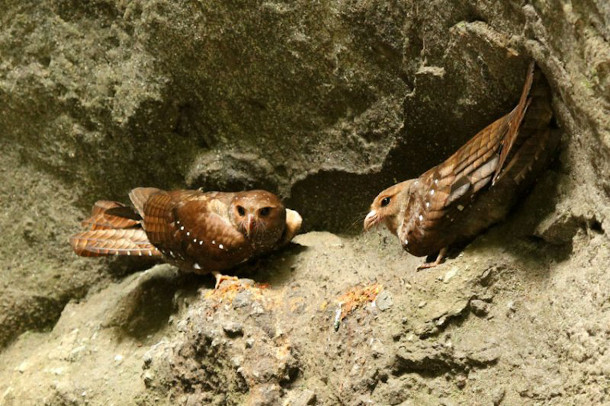
Oilbirds live their whole lives in darkness, emerging from the South American caves where they live only at night. BirdNote®’s Ashley Ahearn shares how oilbirds use echolocation and night vision to forage, and how the bird got its unique name.
Transcript
BASCOMB: It’s Living on Earth, I’m Bobby Bascomb.
CURWOOD: And I’m Steve Curwood
BIRDNOTE THEME
CURWOOD: Birds have evolved in many surprising ways to adapt and thrive, from swimming penguins to hovering humming birds. Ashley Ahearn of Birdnote reports on a South America bird that shares an adaptation with bats.
BirdNote® The Oilbird’s Lightless Life

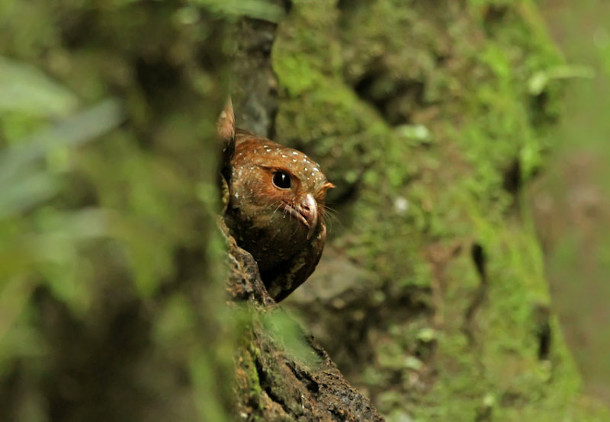
These are the freakish snarls of the Oilbird, which spends its whole life in the dark. These birds live in caves in Trinidad and South America and fly out at night to search for food. The Oilbird is adapted to this lifestyle. It uses echolocation — like a bat — to find its way in the pitch-black of its cave. [Oilbird echolocation clicks and calls] And the birds have excellent night vision — rivaling that of an owl’s — to help them forage after dark. Fossils suggest that the Oilbird diverged from other bird families more than 50 million years ago. It has no close living relatives. [Oilbird echolocation clicks and calls] The Oilbird isn’t black, as its name might suggest. It’s actually a rich brown with large white spots. It has a hooked beak, like a hawk, but it’s not a meat-eater. The Oilbird lives on tree fruit, especially palm nuts and avocados, which it finds thanks to its keen sense of smell. This diet, rich in fat and oils, leads to plump chicks… and the name… Oilbird. In fact, humans used to boil down the birds to make oil.
###
Written by Bob Sundstrom
First set of bird sounds provided by The Macaulay Library of Natural Sounds at the Cornell Lab of Ornithology, Ithaca, New York: Oilbird calls [4559] recorded by David W Snow in Trinidad and Tobago's Arima Valley, in 1959.
Oilbird echolocation clicks and calls recorded by Andrew Spencer in Ecuador.
BirdNote's theme music was composed and played by Nancy Rumbel and John Kessler.
Producer: John Kessler
Executive Producer: Sallie Bodie
Editor: Ashley Ahearn
Associate Producer: Ellen Blackstone
Assistant Producer: Mark Bramhill
© 2015 BirdNote January 2015 / January 2020 Narrator: Ashley Ahearn
ID # oilbird-01-2015-01-27 oilbird-01b
https://www.birdnote.org/show/oilbirds-lightless-life
CURWOOD: For pictures navigate over to the Living on Earth website, LOE dot org