
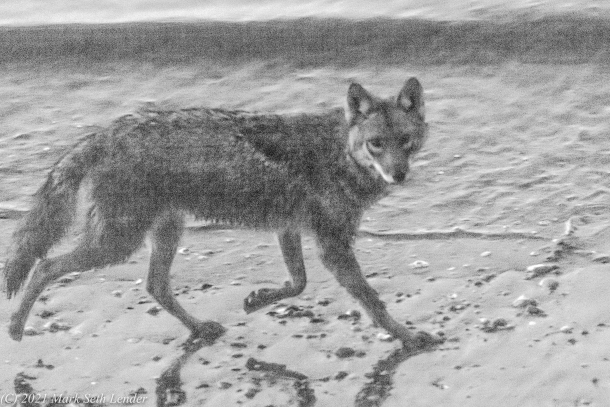
Coyote On The Beach
Air Date: July 02, 2021
Through a combination of gestures, pitch and volume, herring gulls are able to “speak.” With each variation of visual and linguistic components, these gulls are able to vocalize “phrases,” communicating alarm calls and signals. Take a listen as Living on Earth's Explorer-in-Residence Mark Seth Lender narrates a scene of herring seagulls taking a stand against a coyote.
Transcript
CURWOOD: It’s Living on Earth. I’m Steve Curwood
BASCOMB: And I’m Bobby Bascomb. We travel to Connecticut with Living on Earth’s Explorer in Residence, Mark Seth Lender.
LENDER: The herring gulls are circling. They wheel and wheel as they move down the shoreline calling, Look! Look here! Look out! That’s what their voices mean. Thin. Uncertain. A frisson that passes through the flock.
It is impossible to see what they see. The sun is never awake at this hour. The only light is a muddy reddish stain that pulls up behind them in the sky. What disturbs the herring gulls must be close enough to be a threat or at least, seem out of place. Like house cats they notice anything they are not used to. Even the crack in the seawall that opened after the storm which they did not like at all. They are low, maybe fifty feet, and almost overhead now -
and there it is.
Instead of Up I should have been looking down:
Coyote on the beach!
Young, thin, long-legged, he looks more wolf than Song-dog except for the lack of confidence. He glances over his shoulder at the gulls, and again, and then -
He sees me looking right at him.
Coyote loses his trajectory and strays across the tideline. Saltwater lifts in silver arcs from his paws, splashes down, it sounds like the clinking of glass. Other than this he is silent, does not open his mouth, not even to gasp for breath, and continues. Staring as he passes then loping almost at a run.
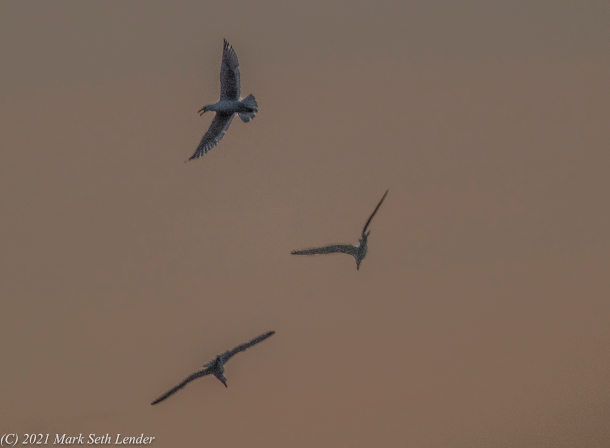
The gulls have given Coyote away. A Human has found him. The thing he feared.
At a large breakwater a hundred yards on he bucks up and at the top, stops and looks at me one last time. Then turns, down between the boulders, and again onto the sand and settles into his stride going west at a steady trot until in the grayness and the distance he is lost from sight...
The herring gulls disperse.
Everything is back to normal.
BASCOMB: That's Living on Earth’s Explorer in Residence Mark Seth Lender.