
BirdNote ®: The Tui of New Zealand
Air Date: October 15, 2021
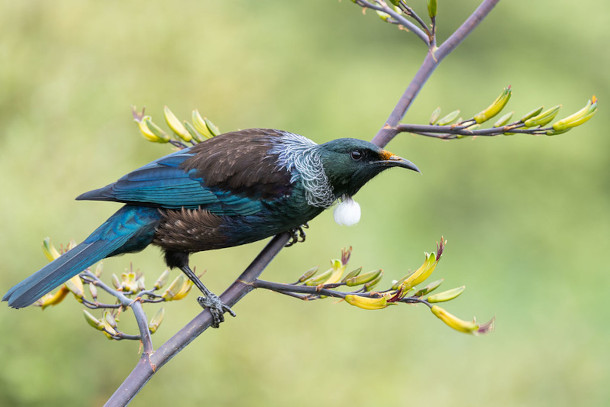
The Tui is one of New Zealand’s most remarkable birds. As BirdNote’s ® Mary McCann reports, these intelligent birds are one of only a few species in the world that can mimic human speech.
Transcript
CURWOOD: We head now to New Zealand with this week’s Bird Note. Mary McCann reports.
BirdNote®
The Tui of New Zealand
The Tui is one of New Zealand’s most remarkable birds. It’s considered an intelligent bird on a level with parrots. And the foot-long Tui is a stunner, feathered in black with a blue iridescent sheen. A lacy white collar adorns its nape, and a distinctive white feather tuft puffs out from its neck like an ascot.
The Tui’s down-curved beak fits perfectly into native flowers, where it feeds on nectar while spreading pollen from flower to flower. Tui also eat native fruits and help disperse the seeds.
Tui aggressively defend their feeding territory of flowering trees from competing nectar-seekers. If a raptor threatens, Tui will fly quickly upward, then dive down on the unwelcome predator with whirring wings.
But the Tui is best known for its voice. Each Tui’s complex song is slightly different, a colorful mix of musical notes and offbeat sounds.
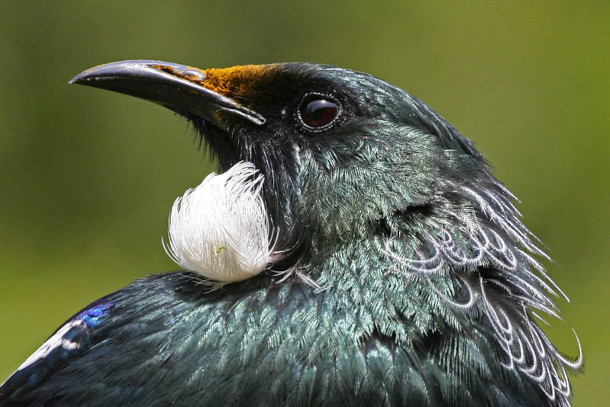
And the most surprising thing about that voice? Tui are one of only a handful of birds in the world that can imitate human speech, and they do it with a New Zealand accent.
Tui whistling and talking, https://m.youtube.com/watch?v=tzPi_998Ghk, 0.01-.13
###
Written by Bob Sundstrom
Senior Producer: John Kessler
Production Manager: Allison Wilson
Producer: Mark Bramhill
Associate Producer: Ellen Blackstone
Digital Producer: Conor Gearin
Bird sounds provided by The Macaulay Library of Natural Sounds at the Cornell Lab of Ornithology, Ithaca, New York. Tui ML 171696 recorded by S. Hill.
BirdNote’s theme was composed and played by Nancy Rumbel and John Kessler.
© 2021 BirdNote July 2021 Narrator: Mary McCann
ID# tui-01-2021-07-20 tui-01
https://www.birdnote.org/listen/shows/tui-new-zealand
CURWOOD: For pictures fly on over to the Living on Earth website. That’s LOE.org