
The Impala Imperative
Air Date: March 11, 2022
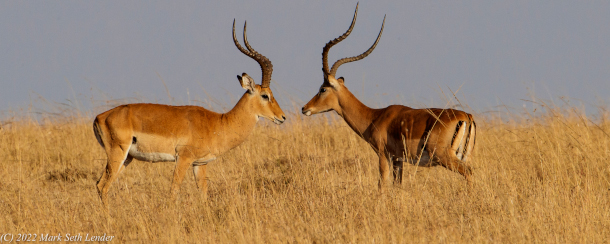
Living on Earth's Explorer-In-Residence Mark Seth Lender shares the secret of how impala antelope living on the African savanna confuse predators.
Transcript
DOERING: Prey animals have evolved many ways to confuse their predators, from a zebra’s stripes to an impala’s back side. Living on Earth’s Explorer in Residence, Mark Seth Lender explains.
The Impala Imperative
© 2022 Mark Seth Lender
All Rights Reserved
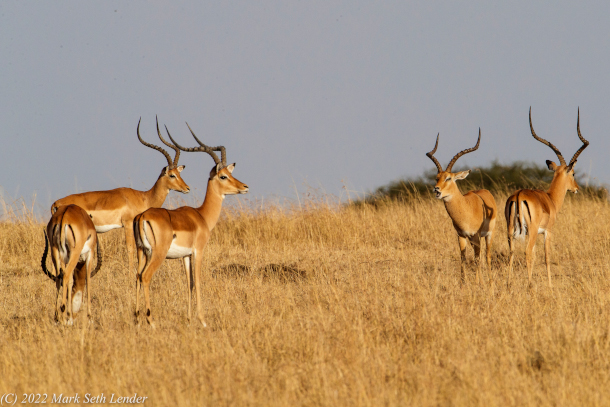
They are magnificent. Common they may be but it is impossible not to feel overawed watching them now on a slope of the rounded hill where they stand in high relief, five in number, their name an onomatopoeia:
Immm-PaLa!! Immm-PaLa!! Immm-PaLa!! Immm-PaLa!! Immm-PaLa!!
You can see them, in that name, bounding across the veldt in sure-footed certainty and grace. In their grass-colored coats even as they graze walking slow their muscles, tight and masculine beneath the skin imply –
Immm-PaLa!!
The females were in that very same place not an hour before. All in a herd of their own. Not like the males who are only near the crest but right on top. Rather to be seen. Than take a chance on hiding low on one side or the other and miss an otherwise apparent danger. With a clear view they see very well. Their legs are very long. No doubt they feel they can outrun anything that comes after them. In aspect, except for a subtle difference in proportion and a hidden capacity for speed, they could be white-tailed deer.
You would never make that mistake with the males. They are what they are. Their horns are nearly half the length of them and ribbed and strong, they curve and curl like an ancient casting made of bronze, the maker and his art lost in history. They stand tall when they stand, their eyes bright as windows; they call to each other mouths open wide.
Unassailable.
As if they have a talisman.
As if they have a secret.
And they do:
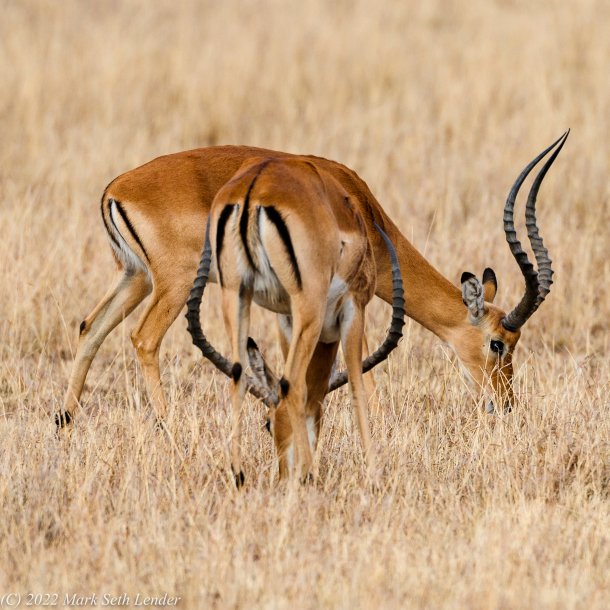
The dark black markings on their buttocks are shaped to the same color and curve as those brazen horns. But upside down! When they bow, to nibble grass, head turning one side to the other to graze, from the perspective of some predator lying in wait, lying low, those horns and these hindmost markings cross.
Confusion!
All the more so when two or three impala are together. Horns high horns low horns crossed and crossing and turning.
“Impa – La? Impa – Low? Impa – LUNGE? No… I don’t think so.”
Early morning and just barely light there they are again, all five, ambling at leisure, chewing the grasses wet with mist close along the trees, in all their confidence and strength. Or is it acceptance? No magic is perfect.
DOERING: That’s Living on Earth’s Explorer in Residence Mark Seth Lender.