
An Interview with the Ocean
Air Date: April 29, 2022

As we close out Poetry Month, we share the timeless poem “I Go Down to the Shore” read by the late Mary Oliver, and a sound rich performance of a creative piece it inspired. Author Kate Horowitz wrote “An Interview with the Ocean” and joined Living on Earth’s Aynsley O’Neill to bring it to the airwaves.
Transcript
DOERING: As we close out Poetry Month, we want to share a timeless poem read here by the poet herself, Mary Oliver.
“I Go Down to the Shore”
Reprinted by the permission of The Charlotte Sheedy Literary Agency as agent for the author. Copyright © NW Orchard 2012 with permission by Bill Reichblum
OLIVER: I Go Down To the Shore
I go down to the shore in the morning
and depending on the hour the waves
are rolling in or moving out,
and I say, oh, I am miserable,
what shall —
what should I do? And the sea says
in its lovely voice:
Excuse me, I have work to do.
DOERING: Mary Oliver won the Pulitzer Prize for a collection of her work in 1983. She passed away in 2019 but her depiction of the Ocean as a steadfast companion in times of trouble continues to inspire other poets like Kate Horowitz. Kate told us she turned to Mary Oliver’s poem at a challenging point in her own life.
HOROWITZ: The morning after what was probably the worst night of my life, I went to a diner and got myself breakfast and brought a book of Mary Oliver poems, because that’s what you do, and I was looking for anything that could help me. And I came across that poem, “I Go Down to the Shore.” And the pragmatic perspective of it really just kind of helped me come down from the intense state of nervous system activation I was in, it really just made me feel like, this is a problem, things are bad, and life is going to go on.
OCEAN WAVES -- HOLD UNDER BELOW SCRIPT AND PHASE IN MUSIC, GULLS
DOERING: And here is the work inspired by that moment, titled An Interview with the Ocean. In it, Kate plays herself and The Ocean is portrayed by Living on Earth’s own Aynsley O’Neill.
MUSIC, SOFT OCEAN SOUNDS, SEAGULLS
HOROWITZ: Good morning. Thanks so much for being here.
O’NEILL: It’s fine. I don’t have anywhere else to be.
HOROWITZ: I have to admit, I’m feeling weirdly nervous about this conversation.
O’NEILL: Why would that be weird? I’m the ocean.
This interview is probably a big deal for you.
HOROWITZ: Well, it definitely is, but we’ve spoken so many times before.
Informally. Off the record.
O’NEILL: Have we?
HOROWITZ: Ouch.
O’NEILL: It’s just that there are so many of you—
HOROWITZ: No, no, I totally understand.
HOROWITZ: [voice catches]: I’m sure I didn’t say anything memorable anyway. [coughs, clears throat]: Anyway. Let’s get into it.
O’NEILL: Sure.
HOROWITZ: In her poem “I Go Down to the Shore,” Mary Oliver recounts an exchange with you that she found particularly meaningful.
She remembers telling you her problems and unburdening the weight from her heart.
O’NEILL: Ok.
HOROWITZ: Your response to her sharing, as Oliver recollects it, was “Excuse me, I have work to do.”
O’NEILL: [chuckling]: Well, that definitely sounds like me.
HOROWITZ: Do you recall that conversation at all?
O’NEILL: I really don’t. As I said, there are so many of you.
And honestly—don’t take this the wrong way—I can’t tell you apart.
HOROWITZ: Ah.
O’NEILL: You all say the same things.
“Oh, I am miserable. What shall—what should I do?”
HOROWITZ: That’s exactly what Mary Oliver said.
Are you quoting her poem? Do you know it?
O’NEILL: No, and that’s my point.
Whoever this person is, she definitely wasn’t the first one to say it, and she wasn’t the last.
I get the impression that you’re all kind of miserable.
HOROWITZ: Yeah. Things have been pretty rough lately.
O’NEILL: Lately?
HOROWITZ: Well, ok. Forever. But more lately.
It’s just…hard. It’s hard being a person.
O’NEILL: So don’t be. Have you tried changing?
Becoming something better?
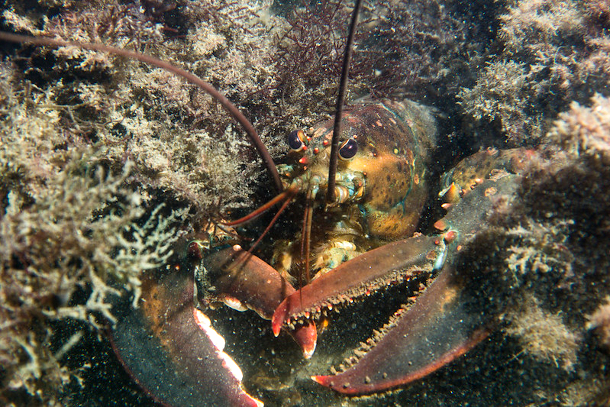
Lobsters seem to have things figured out.
HOROWITZ: I don’t know if I could become a lobster.
I don’t think we get to choose.
[sniffs]
O’NEILL: Are you crying? Are you actually crying in an interview?
An interview you’re conducting?
Don’t you have to be trained to interview people?
Don’t they teach you on like the first day of interviewer school or whatever that you should never cry on the air?
If they don’t, they should. Talk about unprofessional.
HOROWITZ: [sniffling]: Why are you being so mean today?
O’NEILL: Am I? Wait, what do you mean, “today”?
HOROWITZ: [sniffling] I cry with you all the time.
O’NEILL: You do?
HOROWITZ: [blowing nose]: Yeah. I come visit you after work.
I sit with you, and I watch the waves, and I breathe in the salt air, and I cry.
O’NEILL: Why?
HOROWITZ: Why what?
O’NEILL: Why do you come visit me?
HOROWITZ: Well, I—
O’NEILL: Why do any of you come visit me?
[louder]: Why do you think I have the answers?
Why me? I don’t— [voice breaks] [RAIN, THUNDER]
a large wave crashes
HOROWITZ: …Are you crying?
O’NEILL: No. I’m the ocean. I can’t cry.
HOROWITZ: It seems like…maybe you can? And you are?
It’s ok if you are.
O’NEILL: [crying]: Everyone’s just so lost. You’re carrying such heavy burdens.
I don’t know how you can even move. So much suffering.
Even the lobsters! Especially the lobsters.
O’NEILL: [crying]: It’s all of you. And I don’t know how to help.
HOROWITZ: Oh.
a larger wave crashes, then one even bigger.
Hey, hey, hey, hey. Is it ok if I put my hand on your back?
O’NEILL: [sniffling]: Yeah.
quiet splashing sounds
HOROWITZ: Hey. It’s ok. It’s ok.
O’NEILL: [sniffs]: Would you listen to me? I’m such a cliché.
“I’m miserable! And I don’t know what to do.”
HOROWITZ: Oh.
O’NEILL: It’s why I always say I’m busy.
O’NEILL: [laughs hoarsely]: I’m not busy! This stuff basically runs on autopilot.
I don’t even do the tides. That’s all the moon.
[sighs]: I just feel helpless. I see you hurting—each of you—all of you—and I can’t do anything about it.
HOROWITZ: But you don’t have to do anything. That’s kind of the point.
O’NEILL: What do you mean?
HOROWITZ: I don’t come down to the shore so you can fix my problems.
I can handle my problems. I just like being with you.
You don’t have to do or be anything other than what you are.
You’re the ocean! You’re already perfect!
What more could you possibly be?
O’NEILL: [sniffs]: That’s true.
HOROWITZ: Who you are is wonderful.
quiet splashing sounds
Who you are is enough.
DOERING: That’s writer Kate Horowitz and Living on Earth’s Aynsley O’Neill performing Kate’s piece, “An Interview with the Ocean,” which first appeared in the science writing blog, The Last Word on Nothing.