Cliff Hanger
Air Date: March 03, 2023
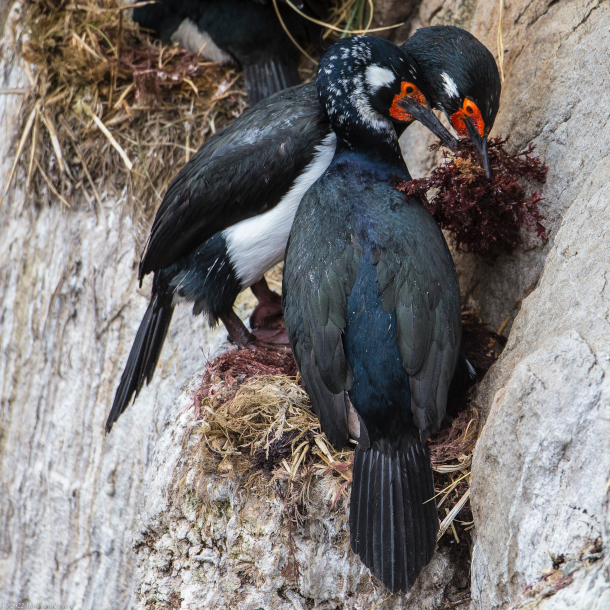
Along the east coast of the Falklands, an agile cormorant soars and dives among the cliffs. Living on Earth's Explorer-in-Residence, Mark Seth Lender, reflects on the empire of this majestic but much-maligned bird.

- 1Cliff Hanger
Transcript
BASCOMB: It’s Living on Earth, I’m Bobby Bascomb.
DOERING: And I’m Jenni Doering
LENDER: Cormorants are a relatively large aquatic bird well known for their diving skills. Some species are so good at hunting fish this way that some artisanal fishermen Asia have been known to tame the birds and use them to retrieve fish. But in the United States cormorants are seen as competition for aquaculture so the government has a program to cull a number of them each year. Living on Earth’s Explorer in Residence, Mark Seth Lender, recently visited the Falkland Islands and got a chance to see cormorants at their best.
LENDER: On the eastern edge of the Falklands, above Land Mine Beach, nearing the limit of the cormorant’s southern reach one flies straight into the cliff! And in the last instant by some vertical magical lift, drops his tail and hovers for a heart, beat. Then plants himself on the narrowest slice of hard granite ledge. Cormorant arrives with gifts. Seaweed, crimson-purple, shaped like tiny pincers all clinging to itself. And the color a complement to the glow of citrine-eyes, and the tangerine-colored faces of him and his mate.
His gift she graciously takes, beak to beak.
Then nodding and leaning and weaving together they restate their deep and mutual vows. Confirming, all that will follow now and the rightness of it. How it should, and must be. And he spreads his wings (the iridescence in the nightblack of his feathers like electricity, the white of his breast a patch of fresh, blown, snow) and steps, out, into empty space.
And drops …
Away…
Once again to work the cold sea.
Black-crowned night herons, their heads adorned with a quill pointed as a hatpin, go about their business and ignore me. Rock hopper penguins, yellow hair flopping come rock-hopping up and up the steep stepstone slope like all their generations before, and before. An oystercatcher cleaving to her nest behind the dunes will not move for anything, or anyone. Defiant. Though, she need not fear.
It is only the cormorant that is truly despised.
On every coast of the Americas; West, and down around Cape Horn; along the length of the Eastern Seaboard here and there and there, cormorants of many kinds shape the sea to their intentions. On the remnant of a volcanic cone off the Antarctic Peninsula, with eyes as blue as glacier ice; under the clear waters of Crystal Spring, rainbows of bubbles chasing behind them; in the turbid saltwater wash of New England where they perch on pilings and spread their pterodactyl wings toward the sun like clothes pinned to the line… I wonder, do they know, the full extent?
To which they are hated.
For the best things about them:
That they fly through water the way they swim through air all of them thinking all the sea belongs to them, and all the little fishes they will find!
When we know the ocean and all things in it, and every turn of the tide belongs only, to us.
DOERING: Mark Seth Lender is Living on Earth’s Explorer in Residence.