Beyond the Headlines
Air Date: March 24, 2023
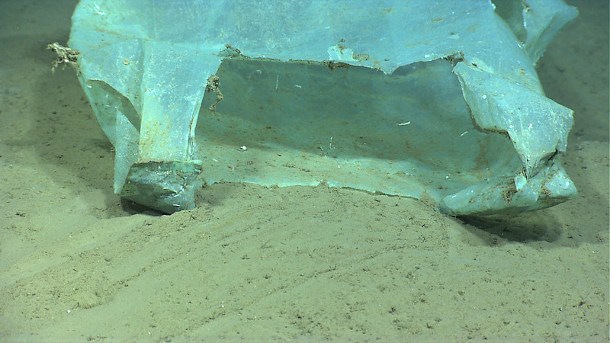
LOE contributor Peter Dykstra shares with host Jenni Doering new research that found plastic bags scouring the deepest parts of the ocean floor. Also, a huge Sargassum seaweed mass is making its way toward the Florida coast just in time for Spring Break. And in the history books, the 52nd anniversary of Tokyo Electric Power Company opening the ill-fated Fukushima nuclear reactors which later were the source of one of the world’s worst nuclear disasters.

- 1Beyond the Headlines
Transcript
BASCOMB: It’s Living on Earth, I’m Bobby Bascomb.
DOERING: And I’m Jenni Doering.
It's time now for a look beyond the headlines with Living on Earth contributor Peter Dykstra. He's on the line from Atlanta, Georgia. Hey, Peter, what do you got for us this week?
DYKSTRA: Hi, Jenni we're gonna do an ocean trifecta. In Hakai magazine, which is a great source of information about our impacts on the ocean. They're looking at plastic pollution in the very, very depths of the ocean, specifically, a study in the Philippine trench, off the Philippine Islands, the third deepest ocean area. And what they found there, just like what's been found in other deep ocean areas, is plastic, plastic bags, other plastic waste at the very bottom of the deepest parts of the ocean floor.
DOERING: You know, we're used to seeing plastic trash floating around and blowing around here on the land and maybe at the beach but what kind of an impact is it having all the way down there?
DYKSTRA: Well, here's one thing. And obviously, we don't have all our information in yet from the very limited studies of what lives and thrives and dies in the ocean floor that deep. But scientists have observed plastic bags, sort of barreling across these deep ocean areas pushed by very, very strong currents. And it's believed that when plastic bags dragged themselves along the deep, deep sea floor, they could plow nutrients under. We do know that nutrients that make it to the ocean floor in darkness are pretty rare. The biggest source of them is the decomposition of bigger pieces of potential food near the surface, they dropped down to as much as 10,000 meters in the Philippine trench and if they're plowed under, that makes it even harder for the marine life that's down there to feed and survive.
DOERING: Wow. So reshaping the seafloor itself, not to mention breaking into smaller and smaller pieces all the time and becoming microplastics that some of those critters probably ingest. So Peter, I think you mentioned we have another ocean based story this week.
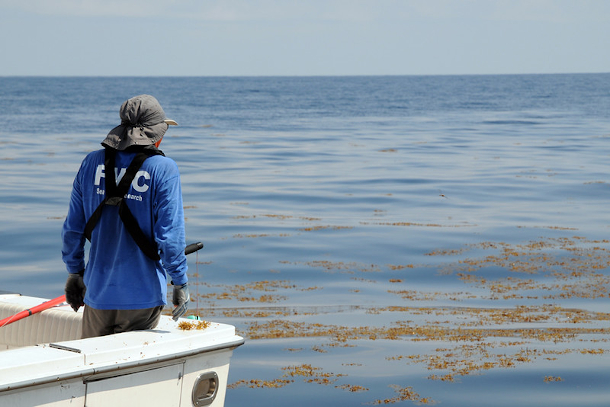
DYKSTRA: Yeah, this is something that's been making the rounds on TV news in the last couple of weeks and that's the gigantic mass of seaweed that is reportedly closing in on Florida. This is Sargassum, and it's been out there forever. It's bigger this year and has generally been bigger in recent years. But Sargassum is a form of weed that reaches beaches and decomposes and when it decomposes, it kinda has a bathroom smell to it. And Sargassum is arriving on Florida's East Coast right now. On the West Coast, is a red tide that's forming as it often does in Florida and elsewhere in warmer waters. And the other thing that's invading Florida at the same time is spring break.
DOERING: [LAUGH]
DYKSTRA: And those three may not add up to pleasant circumstances.
DOERING: Probably not. Well, Peter it sounds like maybe you have experience with this stinky seaweed.
DYKSTRA: Yeah, every year it's in the mid-Atlantic, but it can reach us far on one end as the water Southwest Africa and then into the Gulf. But I've seen and smelled over the years Sargassum arriving in late summer, the beaches of Cape Cod. Not every year but some years. That Sargassum has huge ecological benefits out in the ocean. It provides sort of a nesting area for young sea turtles, and other pelagic, meaning ocean going fishes, to survive and feed and grow. It's gotten bigger in recent years, probably due to the amount of nutrients that go into the ocean waters from major rivers as a result of farm chemicals. Those are encouraging a lot of algae and weed growth, and it could change the ocean ecology even more than it has already.

DOERING: Hmm. Well, what do you have for us from the history books this week, Peter?
DYKSTRA: Well this one has a little ocean tag on it as well. March 26, 1971 the Tokyo Electric Power Company opened the first of six reactors at Fukushima north of Tokyo, and 40 years later that six-reactor complex was the site of meltdown among the reactors when it was swamped by an Ocean Tsunami that was in turn caused by a 9.0 more or less magnitude earthquake. Fukushima, then joined Chernobyl as a symbol of concern about the risks of nuclear power generation.
DOERING: Indeed, well thank you Peter. Peter Dykstra is a contributor for Living on Earth. Thanks and we'll talk to you next time.
DYKSTRA: All right Jenni thanks a lot talk to you soon.
DOERING: And there's more on these stories on the Living on Earth website that's LOE dot ORG.
