Beyond the Headlines
Air Date: June 23, 2023

This week, Living on Earth Contributor Peter Dykstra joins host Aynsley O’Neill to discuss how a batch of hastily crafted hand sanitizer inadvertently released toxic chemicals like the carcinogen benzene. Also, how outdoor activities during the summer are moving indoors due to increasing temperatures from climate change. They follow with REI and Dick’s Sporting Goods banning PFAS forever chemicals in their products. And for history, after a 1907 decision by President Theodore Roosevelt the Owens Valley water was diverted to serve Los Angeles, eventually leaving the valley dry.
- 1Beyond the Headlines
Transcript
O'NEILL: It's time now for a look beyond the headlines with Peter Dykstra. He's Living on Earth's contributor, and he joins us from Atlanta, Georgia. Hey there, Peter, what do you have for us this week?
DYKSTRA: Hi, Aynsley, we've got a few eclectic items. There was a story in Wired magazine about how hand sanitizer had an industry wide boom thanks to the pandemic. The FDA relaxed its rules on how one could make hand sanitizer, and a lot of people got irresponsible to the point where one manufacturer out in the LA area had enough nasty things that killed germs and could potentially kill people, that it's hand sanitizer supply exploded and burned. And we're talking about chemicals like the known carcinogen, benzene, and many, many others. People who thought they were protecting themselves from COVID were actually exposing themselves to a whole new set of problems.
O'NEILL: Just a few weeks ago, I did a story where I talked with a scientist about hand sanitizers that contained quaternary ammonium compounds, which are now being linked to antimicrobial resistance. So that's another factor to take in. You gotta be judicious about your hand sanitizer use.
DYKSTRA: Well, I actually made my own three years ago. It's glycerin and alcohol, and a little bit of lemon juice for aroma. I think I'm pretty safe, but now you got me wondering whether I should throw it out.
O'NEILL: Peter, I feel like three year old lemon juice might be a good enough reason to toss it.
DYKSTRA: Oh, you have enlightened me once again, Aynsley.
O'NEILL: All right, and Peter, what else do you have for us this week?

DYKSTRA: Aynsley, I don't know if you went to camp in your summer vacations. I went once, my parents thought it would straighten me out. It actually, in their eyes, made me worse. So I never got to go to summer camp again. But I did spend a ton of time outside. There's a piece in The Atlantic that says that that is changing due to climate change, and warmer summers. The institution of summer vacation is making a change. And more and more of it is happening indoors. We're actually seeing some parks close because of the excessive heat this summer. Even worse, with the intense smoke from Canadian wildfires hitting some of the most heavily populated areas of the country and the American Northeast. And how much of summer memories are going to be impacted by a warming planet?
O'NEILL: One of the camps that I went to that was outdoors was marching band camp, and although I played clarinet, you can't have a kid marching around holding a tuba in that kind of uniform in this kind of weather. That's a recipe for disaster. So, looks like a lot of kids are going to have to start moving those camp stories indoors.
DYKSTRA: Yeah, but if you're going to stay outside, I've got another item that may be a little bit of good news. Dick's Sporting Goods became the second major sporting goods retailer after REI to ban PFAS, the forever chemicals that are of such a high health concern, in all of the Dick's Sporting Goods clothing, other textiles, tents, sleeping bags. And that will be something added to what Dick's calls its restricted substance list, including flame retardants, formaldehyde, phthalates, the plastic softener, and heavy metals as well. And when two industry giants like REI and Dick's make a decision, that tends to cascade down to all the other competitors.

O'NEILL: Well, Peter, do you have anything for us from the history books this week?
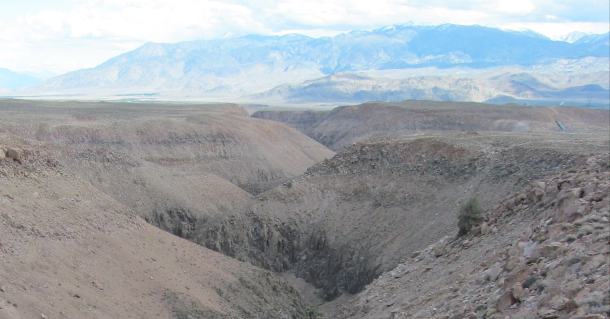
DYKSTRA: Of course, I've got some history for you, Aynsley. This goes back to 1906 when President Theodore Roosevelt decided that Owens Valley in California needed its lake and its river much less than the growing city of Los Angeles hundreds of miles away, needed it. What Teddy Roosevelt said was that the Owens Valley water is, "a hundred or a thousand-fold more important to the state and more valuable to the people as a whole, if used by the city, that being LA, than if used by the people of Owens Valley." That sealed the fate of the Owens Valley, dried up the lake, dried up the river, and turned them into prodigious producers of dust. It was also the first step in major water politics for LA and for so much of the southwestern US. And it also was a major irony, because we remember Teddy Roosevelt as the conservation president, and he absolutely killed off this productive farmland in order to grow a city in the southern part of the state. Now LA is huge, and Owens Valley is dust.
O'NEILL: Alright, Peter, thank you for bringing us all these items. Peter Dykstra is a Living on Earth contributor, and we'll talk to you again real soon.
DYKSTRA: All right, Aynsley. Thanks a lot. Talk to you soon.
O'NEILL: And there's more on the stories on the Living on Earth website. That's loe.org.