Note on Emerging Science: Glass Frogs
Air Date: July 28, 2023
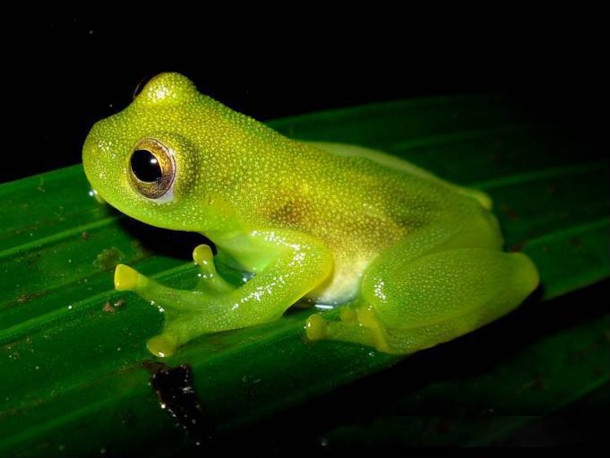
So-called glass frogs have translucent skin, which shows their internal organs. Living on Earth’s Don Lyman reports that these frogs have a special kind of blood that helps them camouflage when sleeping.

- 1Note on Emerging Science: Glass Frogs
Transcript
LYMAN: Glass frogs are a tropical species whose name derives from their translucent skin, which is clear enough to see through to their internal organs and their blood circulating. And scientists have recently discovered that when the tiny frogs sleep in the rainforest at night, 90 percent of their red blood cells disappear into their liver, which hides the cells behind a mirror-like surface. That makes them more camouflaged and harder to spot for hungry predators, like snakes.
Scientists were surprised to find out that, despite the red blood cells being crammed into tiny pockets in the liver for hours, no blood clots formed. When the sleeping frogs awaken, their blood cells unpack themselves from the pockets in the liver and begin circulating again.
The scientists were able to observe the hidden blood cells by using a technique called photoacoustic imaging, which showed the interior of the frogs’ livers by using subtle vibrations created by light striking various molecules and causing slight energy releases.
Some vertebrates are even more transparent than glass frogs. Larval stages of some fish, such as tarpon, eels, glassfishes, and Asian glass catfish, are almost perfectly transparent.
But having a transparent body on land or sea can have clear advantages.
That’s this week’s note on emerging science. I’m Don Lyman.
