From the History Books
Air Date: July 05, 2024
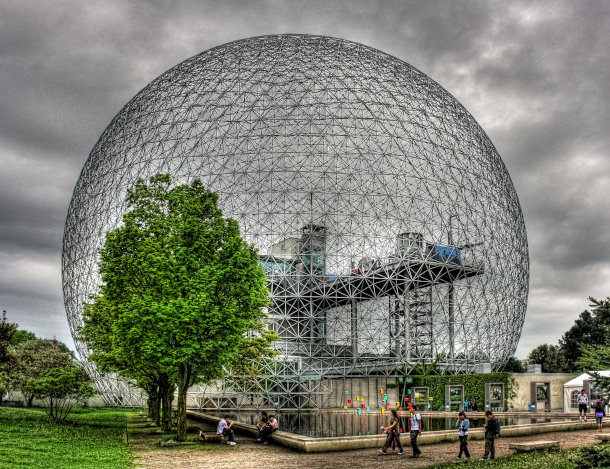
This week, Living on Earth Contributor Peter Dykstra and Host Aynsley O’Neill celebrate the birthday of Buckminster Fuller, inventor of the geodesic dome and other engineering marvels aimed at improving energy efficiency. They also look back to President Nixon’s proposal to create two new federal agencies consolidating US work on environmental regulation as well as on oceans, atmosphere, and weather, giving rise to the EPA and NOAA.

- 1From the History Books
Transcript
DOERING: It’s Living on Earth, I’m Jenni Doering
O'NEILL: And I'm Aynsley O'Neill.
It's the time in our show where we give a call to Peter Dykstra. He's the Living on Earth contributor who brings us stories from the history books. And he's on the line now from Atlanta, Georgia. Hi there, Peter. What do you have for me this week?
DYKSTRA: Hi, Aynsley. We'll start with a birthday of a giant in the fields of science and environment. Back on July 12th 1895, the futurist R. Buckminster Fuller was born in Milton, Massachusetts. He developed the geodesic dome, and other structures intended to make construction less costly and more energy efficient. He was fond of doing more with less. He also toyed with more energy efficient cars, exhibited them at the World's Fair in Chicago in the 30s. And on the personal side, he got thrown out of Harvard, not once but twice, and was a World War I veteran. In a novel attempt at improving science communication, he converted some of his lectures into verse. And because of that, he was appointed to a poetry professorship at Harvard, the same school that threw him out twice.
O'NEILL: Okay, wow. When I was in school, I used to rewrite song lyrics to be about, you know, photosynthesis or the dustbowl or whatever, as a study technique. It's nice to know that there's a rich history behind that, all right.
DYKSTRA: A rich history, but it didn't get you to a professorship at Harvard, I'm sorry.
O'NEILL: It didn't, but I can give a great rendition of just Dust Bowl-ian Rhapsody whenever we get the rights.
DYKSTRA: I look forward to hearing it.
O'NEILL: All right, Peter, what else do you have for me this week?
DYKSTRA: Another July anniversary, July 1970, when the US President Richard M. Nixon proposed two new federal agencies to consolidate US work on environmental regulation, as well as on oceans, atmosphere, and weather. Within the year, the EPA, the Environmental Protection Agency, and NOAA, the National Oceanic and Atmospheric Administration, were both in business.
O'NEILL: And now almost 55 years later, those agencies are kind of the bread and butter of environmental policy in the United States. It's a little strange to think that they didn't exist before then, actually.
DYKSTRA: And also a little strange to think that they added to the unlikely environmental reputation of Nixon.
O'NEILL: All right, well, thanks as always for bringing us these stories, Peter. Peter Dykstra is a Living on Earth contributor and we will talk to you again soon.
DYKSTRA: Aynsley, thanks a lot and we'll talk to you soon.
O'NEILL: And there's more on these stories at the Living on Earth website, loe dot org.