Life on Europa?
Air Date: August 09, 2024
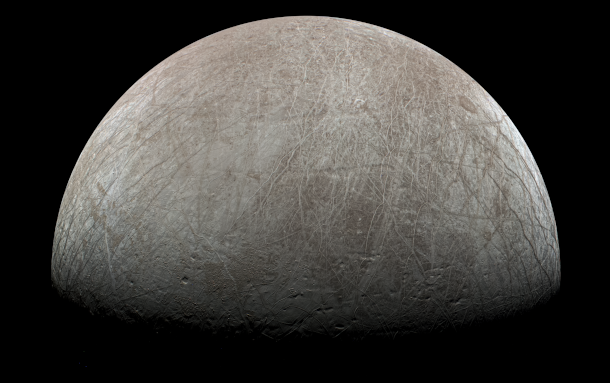
Jupiter’s moon Europa is one of the most promising places to look for extraterrestrial life. Europa has a large liquid ocean beneath its icy crust, so NASA plans to launch the Clipper space probe later this year to investigate. As part of the mission NASA is sending a poem to space. US Poet Laureate Ada Limón reads aloud her poem, “In Praise of Mystery: A Poem for Europa.”

- 1Life on Europa?
Transcript
DOERING: Mars isn’t the only promising place in the search for extraterrestrial life. Another big possibility is Europa, one of Jupiter’s many icy moons. Europa has captured the human imagination for centuries: it was first described independently by Simon Marius and Galileo in the 17th century. Nearly as big as our moon, its icy surface makes it a fairly bright object in the night sky, so much so that Galileo could spot it on just a 20-times magnifying telescope. And Aynsley, amateur telescopes these days are often much stronger.
O’NEILL: But Jenni, in the modern day, we’re not simply looking up through our telescopes. We’re sending spacecraft to get up close and personal in the hopes that Europa might show signs that we’re not alone in the universe. Astrobiologists consider liquid water to be an important factor for life, and under an icy crust Europa seems to have almost double the amount that Earth has in its oceans. Water helps sustain vital processes for life from dissolving nutrients to allowing cells to get rid of waste. Two more key ingredients for life are chemical nutrients and energy. Most organisms on Earth get our energy from plants and bacteria that use photosynthesis to harvest light energy from the Sun. But the thick icy crust on top of Europa’s oceans would block the liquid water from receiving the light from the Sun.
DOERING: Huh. So Aynsley, what does that mean for the chances of life on Europa?
O’NEILL: Well, luckily, there are a couple of ways life could still find energy on Europa. One of these actually happens right here on Earth, at the hydrothermal vents at the bottom of our oceans. Europa seems to have a rocky seafloor just like Earth, and if there’s hydrothermal activity there, then organisms could subsist on the chemical building blocks and energy created in that environment. Life might also arise even in a light-starved ocean thanks to Jupiter blasting its moons with energy in the form of radiation.
DOERING: Oh, that’s cool. No wonder we’re taking a closer look!
O’NEILL: Right! Drawn by the possibility that life could exist on Europa, space agencies around the world are turning their eyes and their funding towards further exploration of this icy moon. NASA’s Europa Clipper space probe is set to launch in October of this year. Once it settles into orbit around Jupiter, it will make a series of flybys over Europa’s surface with the goal of studying the moon’s geology and chemical composition and confirming the existence of the liquid water ocean. The Clipper mission lines up with the Jupiter Icy Moons Explorer, aka JUICE, launched by the European Space Agency in 2023 to look at Europa and two other large icy moons. These missions might one day yield some answers about the potential for life outside our planet. But we’ll just have to be patient since the Clipper mission isn’t expected to reach its orbit until 2030. The cargo includes scientific instruments and a poem dedicated to the mission and engraved on a plaque. Here’s U.S. poet laureate Ada Limón reading her poem “In Praise of Mystery: A Poem for Europa.”
Arching under the night sky inky
with black expansiveness, we point
to the planets we know, we
pin quick wishes on stars. From earth,
we read the sky as if it is an unerring book
of the universe, expert and evident.
Still, there are mysteries below our sky:
the whale song, the songbird singing
its call in the bough of a wind-shaken tree.
We are creatures of constant awe,
curious at beauty, at leaf and blossom,
at grief and pleasure, sun and shadow.
And it is not darkness that unites us,
not the cold distance of space, but
the offering of water, each drop of rain,
each rivulet, each pulse, each vein.
O second moon, we, too, are made
of water, of vast and beckoning seas.
We, too, are made of wonders, of great
and ordinary loves, of small invisible worlds,
of a need to call out through the dark.
DOERING: That’s U.S. Poet Laureate Ada Limón reading “In Praise of Mystery: A Poem for Europa,” which will blast off with the Clipper mission in October 2024.