Europa Clipper On Its Way
Air Date: October 18, 2024
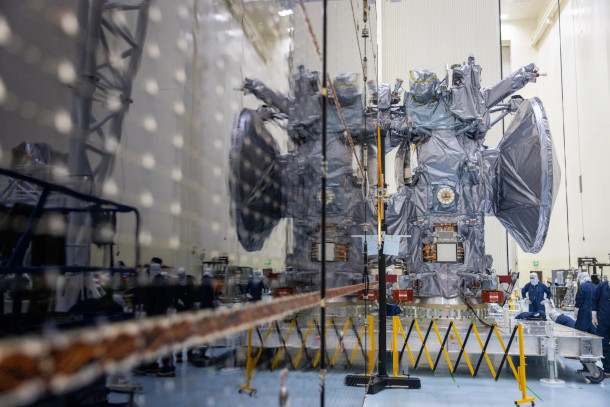
The Europa Clipper spacecraft recently blasted off into space to start a six-year journey towards Jupiter’s icy moon, Europa. On a series of close flybys, Clipper is designed to gather data that could indicate whether Europa might harbor life in the enormous liquid water ocean it appears to have beneath its icy shell.

- 1Europa Clipper On Its Way
Transcript
O’NEILL: After the break we’ll journey to the icy world at the bottom of our planet, Antarctica. But first a quick note on a journey to another icy world that just lifted off. On Monday, October 14th the biggest interplanetary spacecraft ever built by humans blasted off into space. The precious payload of the Falcon Heavy rocket was Europa Clipper, which NASA engineers designed to gather data that could indicate whether Jupiter’s moon Europa might harbor life.
Europa is not exactly Earth-like. For one, Jupiter’s powerful magnetic field zaps its moons with huge amounts of radiation that would be dangerous to us humans. Europa is also so far from the Sun that it receives only about four percent of the sunlight that we enjoy on average. And because of that daytime highs on Europa are a balmy negative two hundred ten degrees Fahrenheit, and nighttime lows can get down to negative three hundred seventy Fahrenheit!
But beneath its thick icy shell, Europa likely has a huge liquid water ocean that just might provide the conditions for microbes to eke out a living. NASA plans to put Europa Clipper on a very elliptical orbit around Jupiter, which will allow it to make dozens of close flybys of the icy moon. But we’ll have to be patient, because it’s expected to take until 2030 just for Clipper to reach Europa. To get that far out into the solar system, the spacecraft will need a couple of gravity assist boosts from Earth and Mars. So if all goes well Europa Clipper should be back in our neighborhood around the end of 2026 before it’s on its way for good.