Event Promo -- Susan Casey on the Deep Sea
Air Date: November 29, 2024
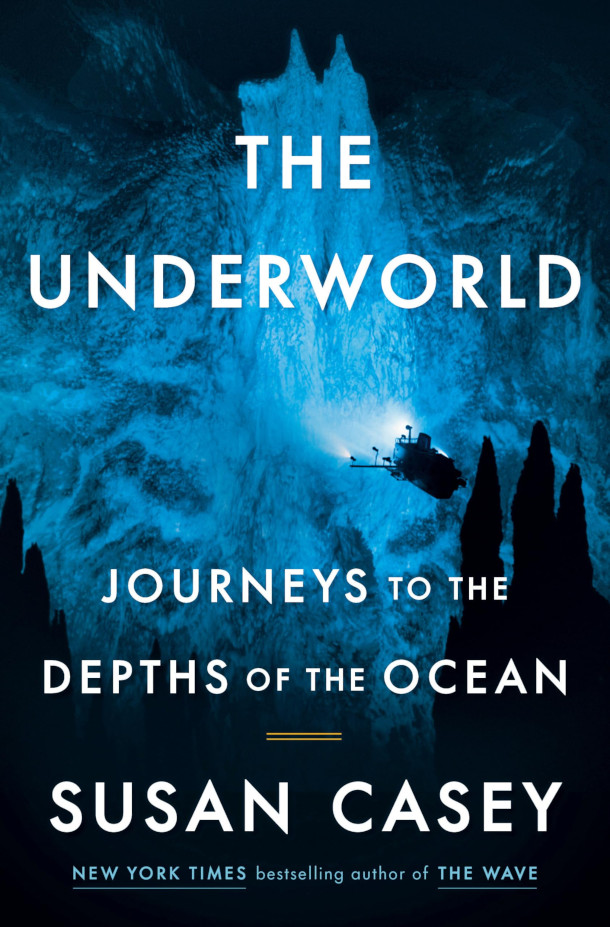
Living on Earth and the New England Aquarium will host a live author interview on December 5 online and in person in Boston. In a promo clip from a previous interview on the show, Susan Casey speaks about the mysteries of the deep ocean captured in her book The Underworld.

- 1Event Promo -- Susan Casey on the Deep Sea
Transcript
CURWOOD: Join us on Thursday, December 5th online or in person at the New England Aquarium in Boston for our next live author event, “Exploring the Deep Sea with Susan Casey.” Susan will discuss her book The Underworld and reveal some of the mysteries of the deep ocean, home to otherworldly marine life, soaring mountains, and smoldering volcanoes. Mysteries like the “twilight zone.”
CASEY: When people think of the ocean, they typically think of the very uppermost layer, which is the sunlight or photic zone, where there's light through the water. And even at the deepest you can scuba dive, you're still seeing sunlight, at least there is sunlight in the water. But below that is the uppermost layer of the deep ocean, and that's the twilight zone or the mesopelagic zone. And that goes from 200 meters, so about 600 feet, down to 1000 meters, so about 3300 feet. And then below that you have another vast midwater area called the midnight zone that goes from 1000 meters to 3000 meters. Below that you have the abyssal zone, or the abyss, which goes - it's the largest ecosystem on Earth, and it's 3000 meters to 6000 meters. And then below that, in certain parts of the ocean, there's the deepest part. It's where the tectonic plates collide and one plate is being subducted beneath another, and that's from 6000 meters almost down to 11,000 meters in the deepest spot in the ocean. That's called the hadal zone. And those deep areas are called hadal trenches, where these tectonic plates are colliding. The Mariana Trench is one that people tend to know. But there are dozens of others. And so the deepest spot that we know of is called the Challenger Deep in the Mariana Trench, and that's 35,867 feet by our latest calculations. It's actually very hard to get an exact depth calculation. And I went as far down as the abyssal zone. I went about 17,000 feet, about 5200 meters. I also went through the twilight zone, which is really amazing, because (@5:37 in original 2-way) I call it the Manhattan of the deep, because there are more creatures living in the twilight zone than in all the other regions of the ocean combined. So it's a really active place and very scenic because all these creatures are illuminating themselves and flashing and blinking and wafting in front of you and sparkling. The abyss is... it took us two and a half hours of free falling to get down into that realm and get the sense that the deeper you go, the more profound it feels. You're definitely aware of the weight, the pressure. I mean, that's 500 atmospheres on your head. There's a gravitas to it. But there's also a serenity, a real serenity. You realize that it is not space, because it's alive. I never forgot where I was. But I was in such awe of where I was that the time goes very elastic, like you could be down there for an hour and you would think you were down there for 15 minutes. There's no signposts. There's none of the things that we tend to look for above, you know, that give us a sense of our surroundings. It's all fluid. It's a spectacular experience that really changes your perspective of your place on Earth. This vast, vast, vast region that we never even think of - it is the vast majority of the Earth. So it's amazing to meet it.
CURWOOD: Join Susan Casey and me on Exploring the Deep Sea, Thursday, December 5th at 6:30 p.m. Eastern, online or at the New England Aquarium. Find out more and sign up for this free event at the Living on Earth website, loe.org/events.
