Bonaire Residents Fight for Climate Justice
Air Date: February 27, 2026
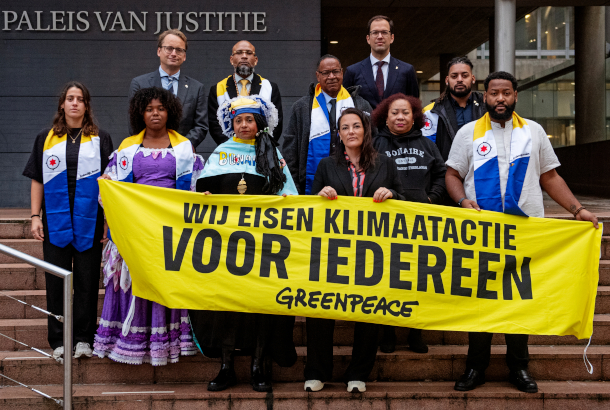
The Dutch special municipality of Bonaire in the Caribbean is already experiencing dangerous heat and could see a fifth of its land disappear under rising seas by 2100. But the Netherlands is discriminating against these overseas citizens by failing to adequately reduce global warming emissions and develop adaptation plans to help them cope, according to a January 2026 Dutch court decision. Greenpeace Netherlands campaigner Eefje de Kroon worked with eight Bonaire residents to bring their case and joins Host Paloma Beltran.

- 1Bonaire Residents Fight for Climate Justice
Transcript
CURWOOD: From PRX and the Jennifer and Ted Stanley Studios at the University of Massachusetts Boston, this is Living on Earth. I’m Steve Curwood.
BELTRAN: And I’m Paloma Beltran.
Due to climate disruption scientists forecast huge rises in temperatures across the tropics. According to the IPCC tropical regions are projected to experience significant warming, nearly 6 degrees Fahrenheit by 2100. And one region that is already feeling the increasing heat is the Caribbean, where islands are facing sea level rise. One of those islands is Bonaire, a special Dutch municipality just off the coast of Venezuela. In a landmark January 2026 decision, the Hague District Court of the Netherlands ruled that its government must better protect residents of Bonaire from climate change, finding current policies are inadequate and discriminatory. The decision requires a specific, binding climate adaptation plan for Bonaire by 2030. And the case could pave the way for climate related lawsuits for other islands and territories like Puerto Rico, which has long sought justice from the US government without success. Greenpeace Netherlands Campaigner Eefje de Kroon worked with eight Bonaire residents to bring their case and joins me now. Eefje, welcome to Living on Earth!
DEKROON: Thank you, very much.

BELTRAN: So the court ruled that the Netherlands breached human rights by treating Bonaire residents as second class citizens compared to residents in the Netherlands. How is the Dutch government's approach to climate change in Europe different to what happens in Bonaire? You know? What does second class treatment look like?
DEKROON: Yeah, this is a really important topic, because this was also the moment in court when the verdict was being spoken, that the mood changed. So it went from like very tense to sort of relief, a sort of like acknowledgement that what the people from Bonaire have been experiencing for years, decades, centuries, even, was finally recognized by a court against the state of the Netherlands. And this is not only the case in the field of climate protection. This is the case in almost every field of life for people on Bonaire. So, a third of people on Bonaire live in poverty. So even also the plaintiffs, they have several jobs just to maintain their families, to make enough money to protect their families.
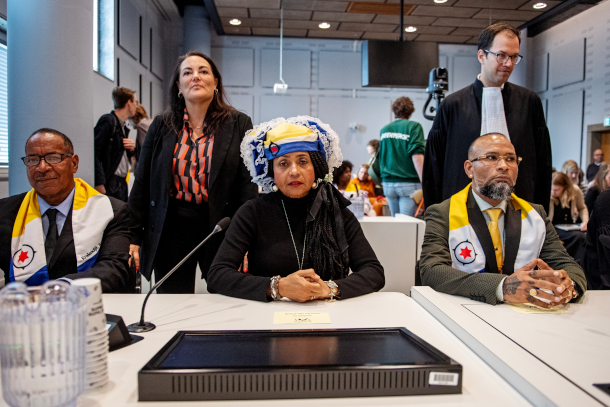
And these people are inhabitants of the Netherlands. They deserve equal protection. But for the European part of the Netherlands, there are all sorts of researches, policies, there are plans. Measures are being taken, often also very expensive measures are being taken to protect the Netherlands from climate change. I mean, a large part of the Netherlands is six meters under sea level, but we don't experience that because we have dikes and we have, you know, we have protection against the water and on Bonaire, not even the research had been done into what the impact would be, let alone that there will be a plan, and that there will be a planning and that there will be financing for it.
BELTRAN: Just under how much threat is the island of Bonaire to sea level rise?
DEKROON: Yeah, so the study that was done by the Free University, they looked at 2050 as the first reference year for the results of the study, and they found that then the first impact of sea level rise will already be visible and will be experienced on Bonaire, so in 25 years. And according to the reports that we did on the basis of that, it shows that a fifth of the island will disappear underwater by the end of this century. And again, if no measures are being taken, right, if we keep emitting the way that we are and no protective measures are being taken. But obviously, what we hope with this campaign and with this lawsuit, which we won, that that will be prevented.
BELTRAN: So Eefje you've had the opportunity to talk with the plaintiffs in this case, you know them personally. You've you've had conversations with them. Is there a story you can share from one of your interactions about how they're experiencing climate change firsthand in Bonaire.

DEKROON: Oh gosh, there are so many, and I'm so impressed by all of them individually. So when we went to Bonaire some years ago, before the study had been done, people already complained about the extreme heat that they were experiencing. And for example, Onnie, he's a farmer, and he said, within just a few years time, I already see that my crops aren't growing as well as they used to. Like, it's too hot and also it's too dry. Water has become too expensive, also to let the crops grow. And also, for example, Helen, she is a grandmother, and she still has her own mother living on the island, who she cares for and she says it's really difficult for me now to walk to my elderly mother in the elderly home because it's too hot during the day and we hardly see kids play in the streets, like kids don't walk to school anymore, like she used to. They take busses now because it's just too hot, and also Judmar, for example, who is a graphic designer and also a taxi driver. And he said that for him, it's personally very important that the slave huts are preserved, because it's a way for him to commemorate his ancestry and where he comes from. So he made artwork as well. On the south part of the island, there is like an abandoned hotel, and there's this big wall that he made a big artwork on which shows what happens if the slave huts disappear under water. So we also try to give a lot of space for art and for expression in this case. And I think, for example, Angelo is the head of a union, a spokesperson for the union. So he's a very strong, very powerful spokesperson. So Angelo, very powerfully says in court, or said, in court, we're not asking for charity. We're demanding justice and I think that's it. I mean, they're tired of being treated as second class citizens, losing a part of their island, losing the possibility to pass it on to future generations, while the Dutch government just has such a clear moral, historical and legal responsibility to protect them.

BELTRAN: So what are Bonaire residents expecting from this decision? You know, what would make them whole?
DEKROON: So that's a big job. But I think in terms of this verdict, it's quite clear that the Netherlands need to cut its CO2 emissions much more quickly than it is planning to do, and it's not even living up to the promises that it has made, but the Dutch court also said you need to pay a fair share. So tell us what your fair share is, or at least what your budget still is. So I think that is something that the plaintiffs are very curious about, how fast the Netherlands will reduce its CO2 emissions. But at least as important is what the Netherlands will now do in terms of the measures that it takes on Bonaire to actually protect people against the heat and against the rising sea levels. And for Bonaire, it still needs to be looked into. What can we do to protect the island against the rising sea levels. But in any case, and this is also something that the court found, is that you need to look at social and economic impacts of the climate crisis and have measures that alleviate that as well. So really take holistic measures that help people. When you live in poverty, like climate change is not the first thing on your mind. So the Dutch government really needs to take responsibility in getting people out of poverty, but also, for example, making sure that people have air conditioning that they can afford, so keeping the energy bills low. In addition to that, having green spaces, sheltered spaces where people can go outside, for kids to play, for people to do exercise outside, this is really important in terms of a heat measure. And you can also think about protecting the corals and the mangroves, because they are very important in terms of identity for the island and for the people. So the corals and the mangroves are really important in terms of identity and economy, because it also protects the island from incoming waves. So it's a natural sort of protective measure that the island has. So these are the kinds of measures that you could think about, and that the plaintiffs also think about in terms of the adaptation measures that need to be taken. The people from the island need to be heard in what they think is an appropriate measure, and the Dutch government really needs to pay up for it.

BELTRAN: And why is this victory significant? You know, what are the implications for other Dutch, British and even French overseas territories?
DEKROON: I really think that this case is a wake up call that governments can be held to a standard of care, and really moves the conversation from should we help these islands to no governments are legally obligated to protect all citizens equally, and this was really the first time that a court ruled that a state discriminated against its own people by failing to develop a climate adaptation plan. So it's not just about the responsibility for causing climate change, but also it's about failing to prepare for the inevitable impacts. And also the U.S. has overseas territories, I know, and in Europe, there are still a lot of countries that also have overseas territories, and we know that they know that they are on notice now, because if this holds true for the Netherlands, and this case is built on international human rights law, there's a lot of reference to United Nations standards. This is the case like this is a universal sort of standard that is being developed here. And that makes sense, because there's already been a body of law that has been developing. And I know the U.S. is often - it's a bit complicated, right by leaving the Paris Agreement, but I know that U.S. judges also look at international rulings as persuasive authority. And I think this case just shows that climate change is a fundamental human rights violation, and there's also customary law that lies at the basis of it. And I think from here on, we're going to see a lot more cases that well, this case can be copied in many jurisdictions. It is really like a blueprint. And I think we'll start to see cases that will go even further, because people are actually suffering financial and personal and health damages, and countries and people need to be held responsible for this.
BELTRAN: Eefje De Kroon is a campaigner for Greenpeace Netherlands. Thank you so much for joining us.
DEKROON: Thank you so much for having me.
Related Links
- ClimateintheCourts.com | “Court Rules Dutch Climate Policy Violates Human Rights”
- New York Times | “Court Orders the Netherlands to Protect a Caribbean Island from Climate Change”
- Greenpeace | “‘The Impact of Climate Change on Bonaire: An Analysis of Different Scenarios and Their Impact on a Dutch Caribbean Municipality’”
- Read the ruling from the Hague District Court.
- Greenpeace | “The Netherlands Violates Human Rights by Failing to Protect Bonaire Residents from Climate Crisis: Court”
- Greenpeace | “New Research: Climate Change Could Have Devastating Impact on Bonaire”
- The Guardian | “Dutch government discriminated against Bonaire islanders over climate adaptation, court rules”
- Environmental Law Alliance Worldwide | “Trailblazing Bonaire Climate Case”
- AP | "Dutch government is ordered to protect residents on Caribbean island of Bonaire from climate change"
- Vrije Universiteit Amsterdam Study | "The impacts of climate change on Bonaire"