Note on Emerging Science: Electric Honeybees
Air Date: February 17, 2023
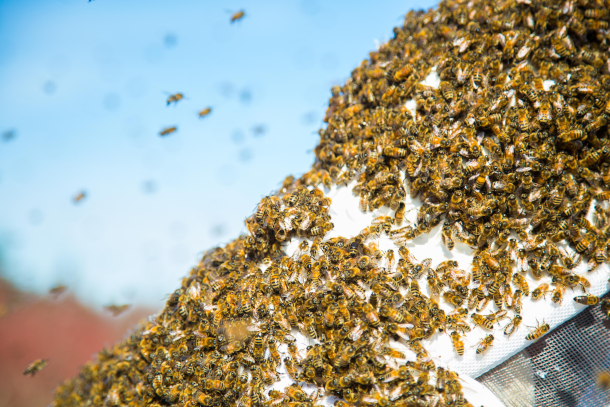
A recent study from the University of Bristol reveals how large insect swarms may affect the electrical charge of the atmosphere. Living on Earth’s Fern Alling explains the phenomenon and the findings.

- 1Note on Emerging Science: Electric Honeybees
Transcript
ALLING: The Earth’s atmosphere holds an electric charge that is present even on clear, sunny days. This charge can be affected by things like lightning, precipitation, and radioactivity. Now, a study published in the journal iScience is pointing to another possible source of electric disturbance: insect swarms. The study was conducted by researchers at the University of Bristol School of Veterinary Sciences. They set up two electric monitors at a field station where several honeybee hives are kept. One monitor was placed near the hives, while the other was placed in an open field 150 feet away. Insects generate small amounts of static electricity when they fly, and it’s caused by the friction between their wings and surrounding air molecules. When swarms of bees passed over the monitor near the hives it detected changes in atmospheric charge, but the control equipment in the field did not. Using the data generated by their experiment, measurements of individual insects, and scientific records, the researchers developed a model to predict how swarms of different insects might affect atmospheric charge.
They found that the larger the insects and the more tightly they were packed, the higher the swarm’s charge density would be. One swarm of honeybees they measured had a charge density of 1,000 volts per meter, about eight times greater than a storm cloud’s.
But honeybee swarms are far smaller than clouds, so it’s unlikely bees have a similar impact on the weather. Locusts, on the other hand, can create massive swarms that span hundreds of miles, creating an even larger localized charge than bees. Scientists are still working to understand the overall impact insect swarms have on the atmosphere. But these initial findings were a shocking start. That’s this week’s note on Emerging Science, I’m Fern Alling.