BIRDNOTE®: Birds and Plants of Hawaii
Air Date: September 08, 2023
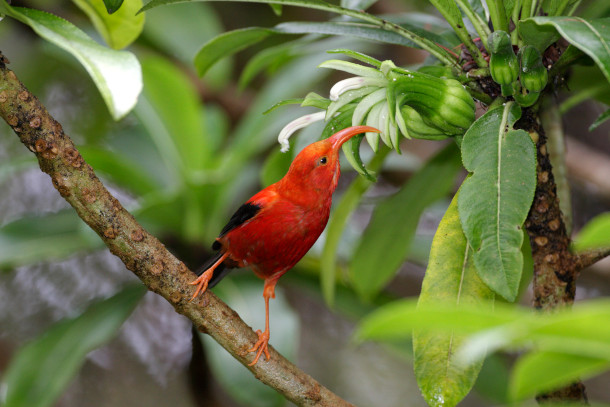
For millions of years the Hawaiian Islands have been forged with fiery lava, a destructive as well as life-bringing force. BirdNote®’s Michael Stein reports on how this rocky archipelago became so abundant in life.

- 1BIRDNOTE®: Birds and Plants of Hawaii
Transcript
BIRDNOTE THEME
BELTRAN: For millions of years the Hawaiian Islands have been forged with fiery lava, a destructive as well as life-bringing force. BirdNote®’s Michel Stein reports on how this rocky archipelago became so abundant in life.
BirdNote®
The Birds and Plants of Hawaii
A volcano erupting
Massive volcanic eruptions brought forth the Hawaiian Islands from deep beneath the sea. [A volcano erupting]
How did these remote islands of lava rock grow lushly green with plant life?
[Waves] Birds played a vital role. Birds like the Pacific Golden-Plover we’re hearing now. [Pacific Golden-Plover calls]
Three-quarters of Hawaii’s native flowering plants probably came from seeds that hitched rides with birds. [Pacific Golden-Plover calls]
Plant seeds travel with birds in several ways. Sticky or barbed seeds adhere to the feathers — much like the seeds stuck in your socks after a walk in a weedy field. Other seeds travel in mud caked on a bird’s feet. And still others cross the ocean in the stomachs of birds. [Pacific Golden-Plover calls]
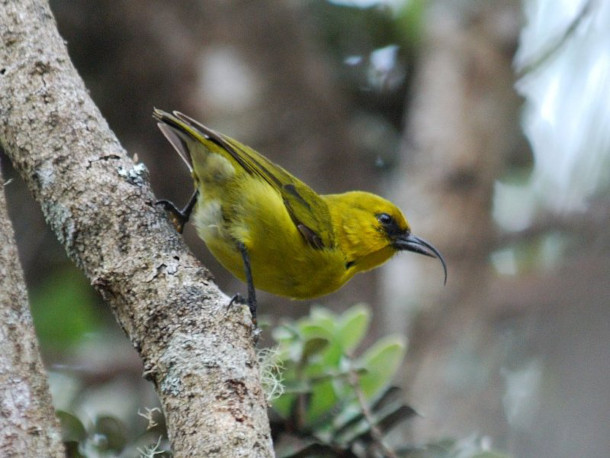
The bird-borne seeds that sprouted in Hawaii evolved into more than a thousand new species. The most likely seed-carriers were strong fliers like plovers or tropicbirds, which travel thousands of miles across the Pacific. [Red-tailed Tropicbird sounds] Or perhaps the seeds hitched a ride on the ancestors of this Akiapola’au we’re hearing — caught in a storm and blown to the Hawaiian Islands. [Akiapola’au calls]
Learn more at BirdNote.org.
BELTRAN: For pictures, soar on over to the Living on Earth website, loe.org.