Beyond the Headlines
Air Date: February 02, 2024
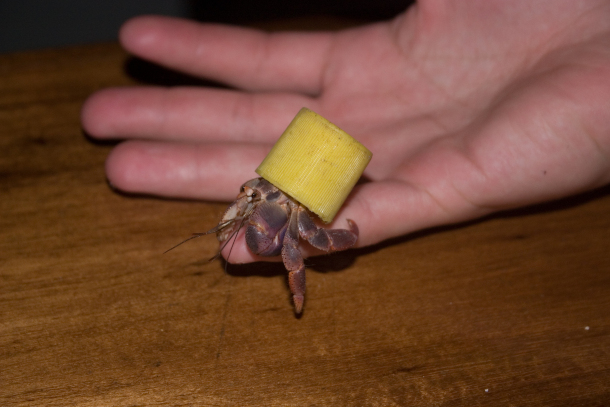
This week, Living on Earth Contributor Peter Dykstra joins Host Jenni Doering with news of a study that found hermit crabs are using plastic trash as their homes instead of seashells. Also, New Jersey approves two major offshore wind projects that could power 1.8 million homes. And in history, they remember when Jacques Cousteau published The Silent World and revealed the mysteries of the oceans.
- 1Beyond the Headlines
Transcript
O’NEILL: It’s Living on Earth, I’m Aynsley O’Neill.
DOERING: And I’m Jenni Doering.
Down in Georgia, Living on Earth Contributor Peter Dykstra has some stories from beyond the headlines he’d like to share. Hey, Peter, what’s on tap this week?
DYKSTRA: Hi Jenni, we've got a lot of stuff from the water. Number one is based on a study from a team of scientists in Poland, publishing in the Science of The Total Environment Journal, and they have found hermit crabs, those adorable little crustaceans you see running up and down the beach whose shells are borrowed, usually, from other species. But in this study, they found 386 examples of hermit crabs who found garbage as a more acceptable home than another animal's shell. Those more innovative hermit crabs, if that's in fact what they are, were using plastic bottle caps, sometimes small pieces of metal or glass. And while this doesn't constitute any kind of a majority of hermit crabs, hermit crabs could be the latest manifestation of how plastics and other manmade materials are beginning to take over corners of marine life we would have never imagined they'd take over.
DOERING: Well, it certainly does speak to the volume of plastic trash that we're putting out into the environment. You know, Peter, I don't know if you're on TikTok these days. But one of my favorite TikTokers is actually taking some of these hermit crabs, like going out and finding the ones that have these plastic bottles as their home, and offering them a natural home, a shell, and they always move in and seem to enjoy it.
DYKSTRA: I'll have to check it out.
DOERING: Well, Peter, what else do you have for us beyond the headlines this week?
DYKSTRA: My home state of New Jersey, often known as the Garden State, occasionally depicted as the mafia state, lost two big offshore wind projects last year. But after losing those two projects last year, that could have powered a million homes, they're in the midst of signing up two new projects for not just a million but 1.8 million homes worth of electricity from offshore windmills.
DOERING: That is quite a lot of wind power, Peter.
DYKSTRA: It is. And it's a sign that even though there was a little bit of a glitch in the growth of wind power, the confidence is there to make these things work and battle against climate change from the overuse of fossil fuels.
DOERING: Sounds like wind in the sails of offshore wind.
DYKSTRA: That's what it is exactly.
DOERING: So Peter, for history this week, are we sticking with this ocean theme?
DYKSTRA: Yes, we're sticking with this ocean theme. On February 3, 1953, one of the greatest ocean explorers ever, Captain Jacques Cousteau, published his smash hit book, The Silent World. Just absolutely riveting, breathtaking, never-before-seen images of what lies below the ocean surface. Cousteau followed up this book that sold 5 million copies. Later, he did The Silent World as a documentary that eventually won an Academy Award, and he became the master explorer, bringing those images from beneath the oceans to people's living rooms. Cousteau was always a hero of mine, with his documentaries on ABC, and later on TBS. Cousteau kept producing this kind of work right until his death in 1997, and his children and grandchildren continue the work today.
DOERING: I've heard so many people talk about just how influential Jacques Cousteau's work, and bringing the undersea world to the rest of the world, was in shaping our understanding of the oceans.
DYKSTRA: Really, anything you see that's in documentary form, about the oceans or about the sea floor was preceded and certainly inspired by the work of Captain Cousteau.
DOERING: And the ocean is a place we're still discovering. I mean, it's been said that we've mapped more of the moon than we have the ocean floor.
DYKSTRA: And hopefully we'll continue to discover it and protect it before we're discovering the downside, like hermit crabs wearing bottle caps.
DOERING: Well, thank you, Peter. Peter Dykstra is our Living on Earth contributor, and we'll talk to you again next week.
DYKSTRA: Okay, Jenni, thanks a lot. Talk to you soon.
DOERING: And there's more on these stories on the Living on Earth website. That's LOE.org.